Real-Time Alerts for File Changes & Logins
mySites.guru is more than a suite of tools for managing multiple WordPress sites. Used by over 74,000 Joomla and WordPress sites, it also sends you real-time alerts when something happens on your sites - an admin login, a config change, a file that shouldn’t have been touched.
Real-time alerting triggers
Your site notifies mySites.guru based on the preferences you configure: someone logging into the admin console, saving Global Configuration, or other triggers you care about.
We’re always looking to add more triggers - if you have ideas, let us know.
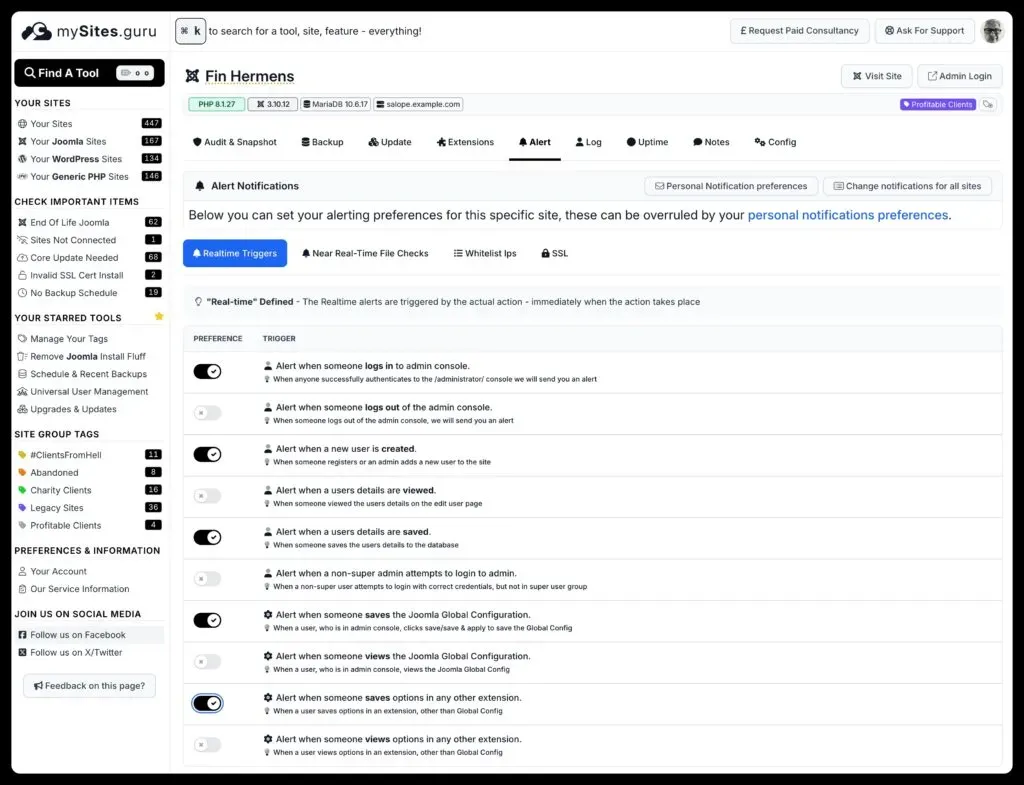 The available real-time triggers for Joomla and WordPress sites
Near real-time file monitoring
You can opt in to have specific files monitored on your site. When a monitored file is modified, your site informs mySites.guru and you get an alert.
This is “near real-time” because the check runs on every page load. If someone edits a file through the Joomla or WordPress admin, the alert fires immediately - the page request that saves the change is also the page request that detects it. The only time there’s a delay is if someone modifies a file over FTP and no one visits the site for a while. Same idea as WordPress’s web-cron.
You can add unlimited files to the watch list, but in practice a short list of important files is enough - your configuration file, template files, and other files hackers tend to target. Not sure which files to monitor? Start by understanding what hidden files are already in your webspace - some of them may surprise you.
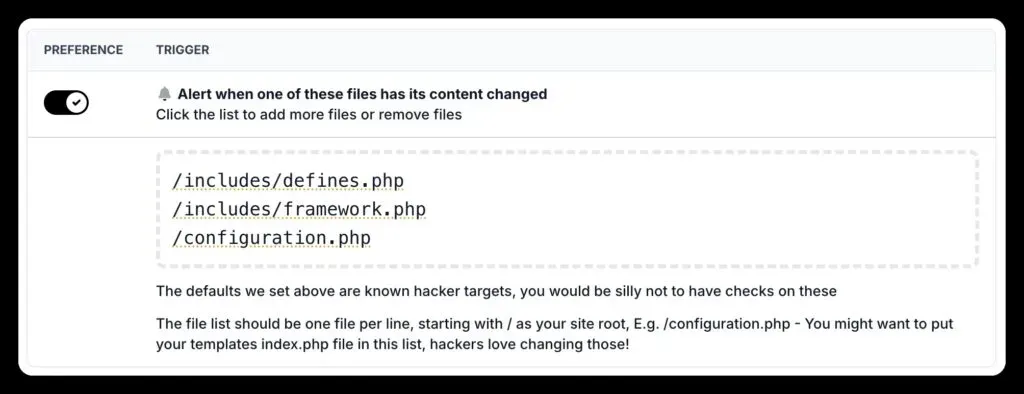
How the MD5 hash check works (the .myjoomla.configuration.php.md5 file)
If you’ve looked at your Joomla site’s file system and found a file called .myjoomla.configuration.php.md5, that’s the mySites.guru plugin doing its job. This is what it does. (For a focused walkthrough aimed at anyone who just stumbled on this file, see what the .myjoomla.configuration.php.md5 files are.)
When you enable real-time file monitoring for configuration.php (or any other file), the mySites.guru plugin calculates the MD5 hash of that file and writes it to a companion file. For configuration.php, the companion file is .myjoomla.configuration.php.md5. It contains nothing but the 32-character MD5 hash string of the file contents at the time it was last checked.
On every single page load - front-end or back-end, any visitor, any page - the plugin recalculates the MD5 hash of configuration.php and compares it to the hash stored in .myjoomla.configuration.php.md5. Two outcomes:
Hashes match
The file hasn’t changed. Nothing happens. The check adds negligible overhead - calculating an MD5 of a small config file takes microseconds.
Hashes don’t match
The file has been modified since the last check. The plugin immediately sends a notification to mySites.guru, which fires an email alert to you (and any team members with access to that site who have that alert switched on in their own preferences). The plugin then updates .myjoomla.configuration.php.md5 with the new hash, so the next page load won’t trigger a duplicate alert for the same change.
This works the same way for every file you add to the watch list. If you monitor index.php, you’ll get a .myjoomla.index.php.md5 file. Monitor wp-config.php on a WordPress site and you’ll get the equivalent companion hash file from the mySites.guru WordPress plugin.
Why configuration.php matters
configuration.php is one of the most important files on a Joomla site. It contains your database credentials, secret keys, error reporting settings, cache configuration, and tmp/log paths. If a hacker modifies this file, they can redirect your database connection, disable error reporting to hide their tracks, or change your tmp path to a location they control.
Getting an alert the instant configuration.php changes means you know about it before the hacker has time to do anything else. You don’t need to wait for a scheduled scan or manually check your files - the next page load catches it.
If that alert turns out to be your own change, or an attacker’s, our web file manager lets you open the file straight from the dashboard to check exactly what changed, no FTP client needed.
Is it safe to delete .myjoomla.configuration.php.md5?
Yes, deleting it won’t break your site. But the mySites.guru plugin will recreate it on the next page load and treat the file as if it’s being monitored for the first time. You won’t get a false alert - it simply recalculates the hash and stores it fresh. If you want to stop monitoring a file entirely, remove it from the watch list in your mySites.guru dashboard instead of deleting the hash file on disk.
Can You Whitelist Your Own IP?
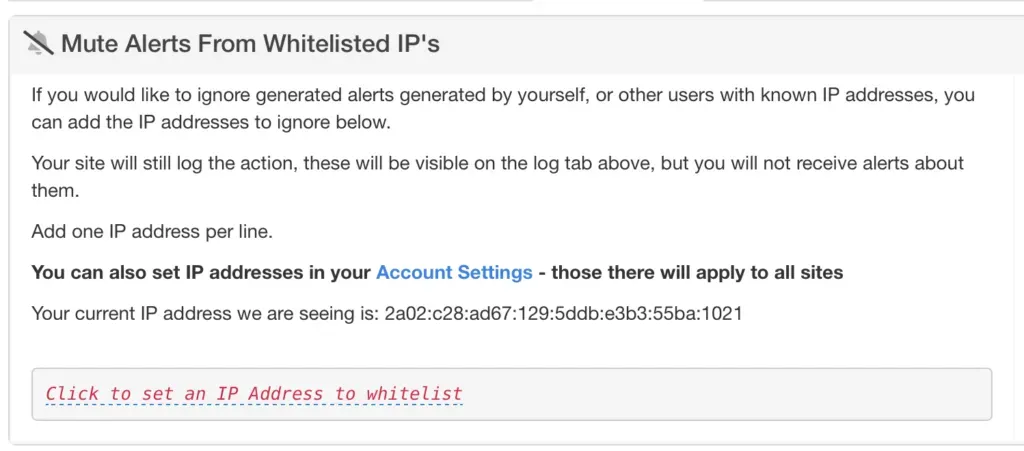
You can whitelist IP addresses so your own changes don’t trigger false alarms. The same principle applies to uptime monitoring - whitelisting our monitoring IP prevents your server’s firewall from blocking the uptime checks.
SSL expiration alerting
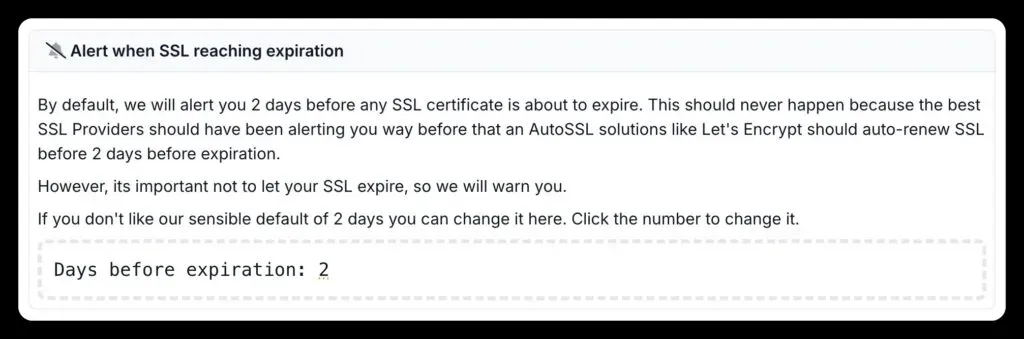
mySites.guru has included SSL certificate expiration alerts since 2012. If your SSL certificate is approaching expiration, you’ll get an alert based on your preferences. You can also set the number of grace days before the alert fires.
Send alerts to multiple people with team members
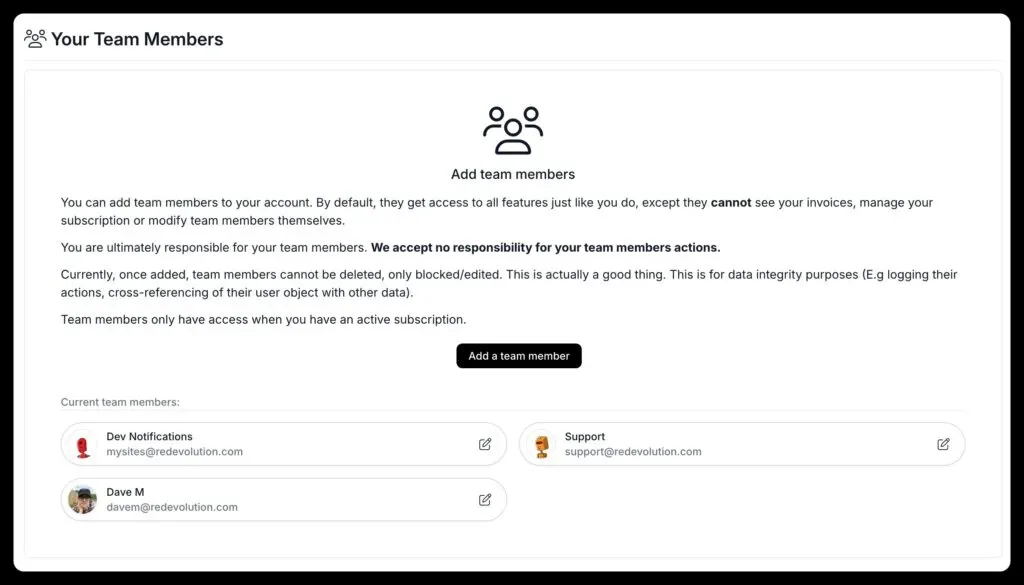
If you want alerts to go to more than one person, add team members to your account. Each one gets their own notification preferences, set on their own account rather than site by site, and each member only receives alerts for the sites they have access to. You can also impersonate team members and configure their preferences on their behalf.
One exception: the Accountant Portal role is excluded from these alerts by default. Accountants only receive billing emails, not operational noise.
Alerting is one piece of what mySites.guru does - check the full feature list, or run a free security audit on one of your sites to see it in action.
Real-time alerting is a core feature in our monitoring and alerting guide.
Frequently Asked Questions
What events can trigger a real-time alert in mySites.guru?
How does mySites.guru detect modified files on my site?
Can alerts be sent to multiple team members?
Why do my per-site alert settings seem to be overridden by my account notification settings?
What is the .myjoomla.configuration.php.md5 file on my Joomla site?
How does mySites.guru monitor configuration.php for changes?
 Written and edited by a human, with AI assistance. Our approach to AI