Web Server disk space monitoring
The mySites.guru snapshot monitors your server’s actual disk partition usage - not your virtual hosting quota - and warns you before it fills up. Some web hosts don’t surface this information at all.
What does mySites.guru measure (and why)?
Every time mySites.guru takes a snapshot of your site (twice daily, or on demand), it calls two standard PHP functions that have existed since PHP 4.1.0:
disk_free_space- returns available space on the filesystem or disk partitiondisk_total_space- returns the total size of the filesystem or disk partition
From those two numbers, we calculate space used and percentage used:
private function getDiskSpace()
{
    if (! function_exists('disk_free_space') || ! function_exists('disk_total_space')) {
        return json_encode(array());
    }

    $data = array(
        'free'  => disk_free_space(JPATH_BASE),
        'total' => disk_total_space(JPATH_BASE),
    );

    $data['used'] = $data['total'] - $data['free'];
    $data['percentUsed'] = sprintf('%.2f', ($data['used'] / $data['total']) * 100);

    $data['free']  = $this->formatSize($data['free']);
    $data['total'] = $this->formatSize($data['total']);
    $data['used']  = $this->formatSize($data['used']);

    return json_encode($data);
}
The stored data looks like this:
{"free":"1.18 TB","total":"6 TB","used":"4.82 TB","percentUsed":"80.31"}mySites.guru shows a warning when the partition is over 85% full, and a critical alert at 95% or more.
⚠️ Partition vs. quota
This is the physical disk partition your site lives on, shared with every other site on the same server. It is not your hosting account quota. Your quota is a soft software limit - it has nothing to do with how much space is physically left on the drive.
“But my web host says my quota is fine”
People hear this a lot. They contact their host, who tells them their account quota is fine. Then they email me saying mySites.guru is wrong.
Two different numbers. Your hosting provider reports your account quota - a software limit they set for your account. mySites.guru reports the physical disk partition - the actual hard drive your files sit on, shared with potentially thousands of other sites.
If the partition hits 100%, your site goes down regardless of what your quota says - and if multiple sites share that server, they’ll all trigger downtime alerts at the same time. You won’t be able to take backups. MySQL may throw errcode 28 (no free space). And your hosting panel will still happily show your quota at “20% used.”
“There’s 1.18 TB free, so I’m fine at 80%”
Using the example data above: all the sites on that server have consumed 4.82 TB between them on a 6 TB partition. That’s a lot of sites sharing one drive.
Say another customer on the same server runs a backup that eats that remaining 1.18 TB. They’re within their own quota, but the physical disk is now full. Your site is offline.
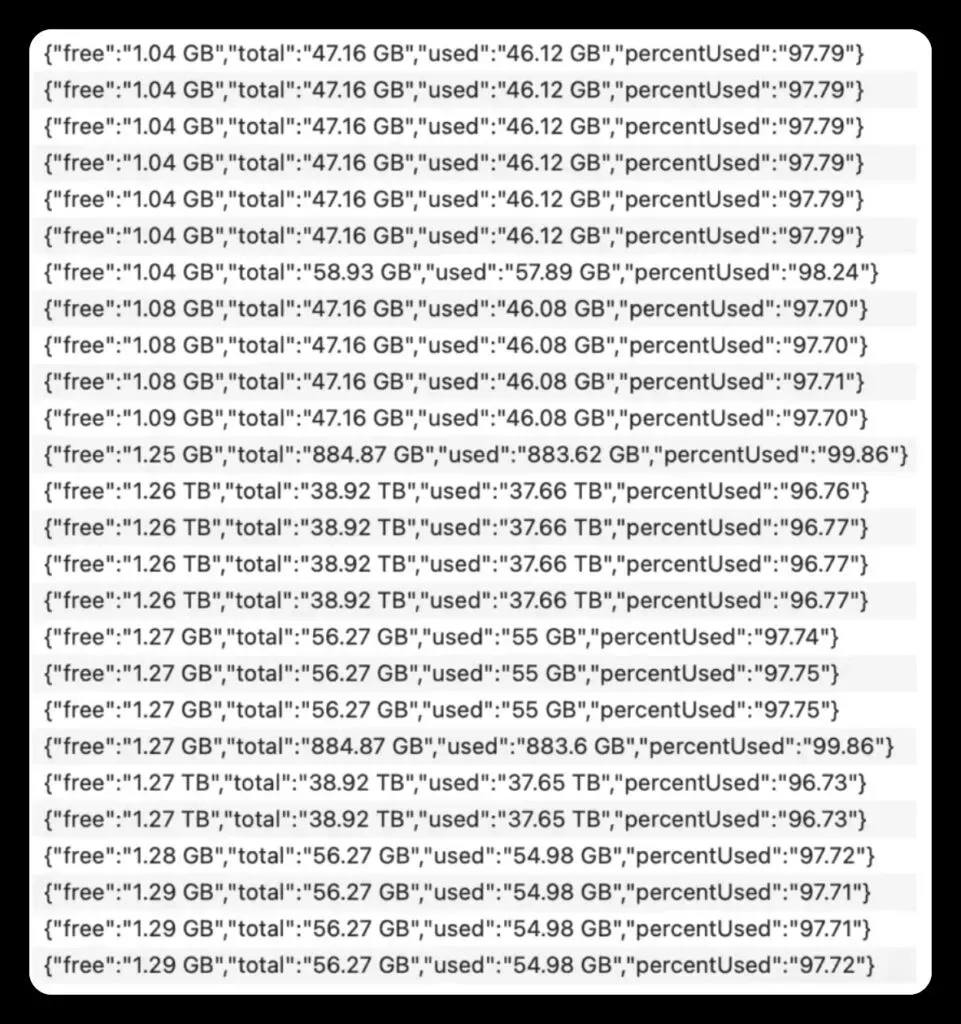
That’s an extreme scenario, but we’ve seen plenty of hosts running partitions above 95%. We’ve seen servers with as little as 1 GB of free space remaining - on major hosts.
How do you disable disk space warnings?
If you’d rather not see these alerts, you can turn them off. Go to Notifications & Preferences, open the Settings & Preferences tab, and toggle off “Show webhost disk space warnings.”
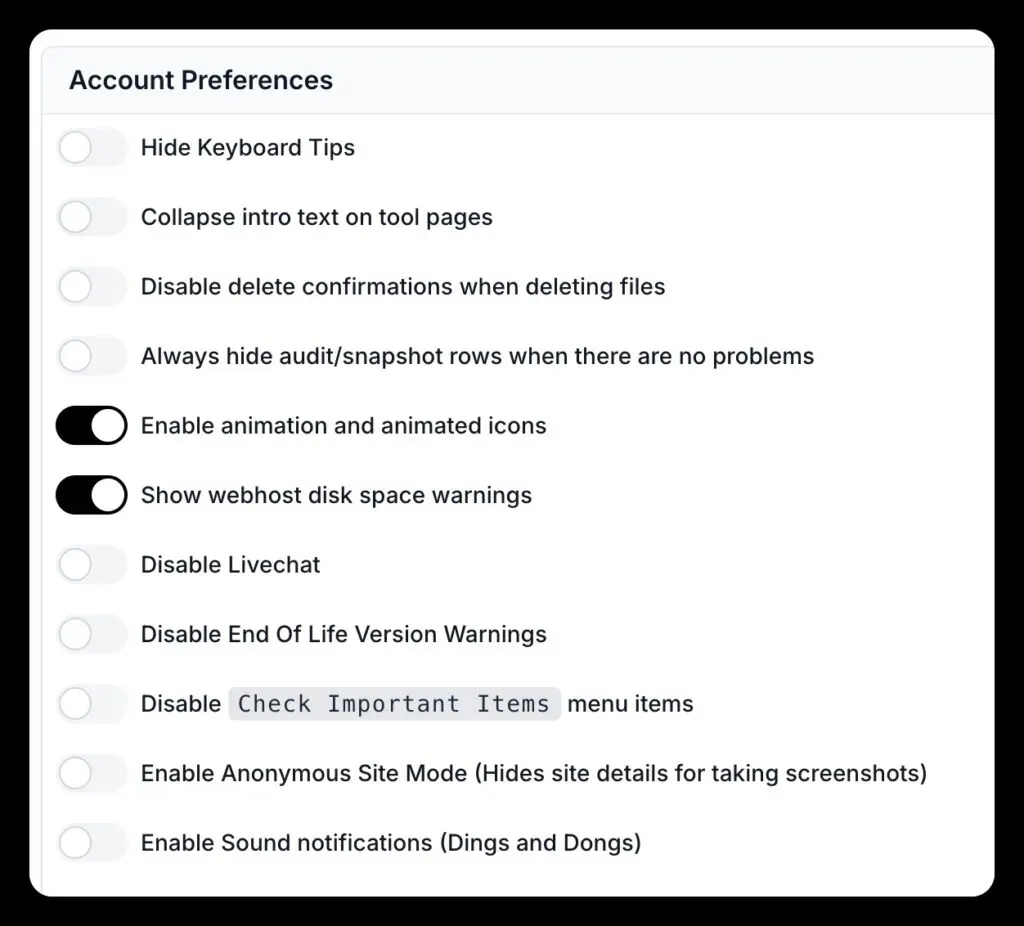
“My quota is at 20% but you’re showing 97%”
That’s because they’re measuring different things. Your quota is a soft limit set by your host. The 97% is the physical partition your site runs on. Your quota could show plenty of room while the actual drive is nearly full.
In fact, you might try to upload files well within your quota and fail - because the physical disk filled up first.
Why are the percentages so high?
Shared hosting providers pack as many sites onto the same hardware as possible. That’s how the economics work. It’s common for mass-market hosts to run partitions at 80-90%+ utilisation.
The mySites.guru thresholds are 85% for a warning and 95% for critical. The severity depends on partition size: 95% on a 20 GB partition leaves almost nothing, while 95% on a 10 TB partition still leaves 500 GB free.
What should you do with this information?
Like everything else in mySites.guru, we report what we find and give you the tools to act on it. Use the information, ignore it, or disable the feature entirely. Your call.
Disk space monitoring is part of our site monitoring guide.
Frequently Asked Questions
What is the difference between the disk space warning in mySites.guru and my hosting account quota?
When does mySites.guru trigger a disk space warning or critical alert?
Can I disable the disk space warnings if I don't want to see them?
 Written and edited by a human, with AI assistance. Our approach to AI