Update Joomla, WordPress and Every Plugin Across All Your Sites
Updating is the job mySites.guru customers do more than any other. Joomla core, WordPress core, Joomla extensions, WordPress plugins and themes: across a portfolio of client sites there are new versions on offer most days. Pressing Update is easy. The work is in knowing which of several hundred waiting updates matter today, applying them without flattening a shared server, and making sure the one update you know breaks a site is not applied by a colleague on a Friday afternoon.
Patchstack’s State of WordPress Security in 2026 counted 11,334 new WordPress vulnerabilities disclosed in 2025, 91% of them in plugins and 9% in themes, with 6 in core. For the heavily exploited ones, the weighted median time from disclosure to first exploit was 5 hours, and 46% had no developer fix at the time of disclosure. When the fix does arrive, the window for applying it is short.
This is the long version of how to update Joomla and WordPress sites from mySites.guru, built on 14 years of doing exactly this since it started in 2012 as the Joomla Health Checker, across 90,000+ sites protected and 1,000,000+ audits completed. It covers core and extensions on both platforms, the Updates page and its security-first filtering, backing up before updating, the per-server queue, snooze and pause, auto-updates, download keys, the log and alerts, the API, and the routine I recommend. If you only want extensions and plugins, the focused how-to gets you there in a few minutes.
Where do the updates show up?
They show up in the left menu before you go looking. The Needs Attention section of the mySites.guru menu has a row for Core Update Needed, with the number of sites where Joomla or WordPress is behind its latest release, and a row for Updates To Do, with the number of Joomla extension, WordPress plugin and theme updates waiting across all of them. The counts come from snapshots, which run twice a day on each connected site, so the menu reflects what each site would offer if you logged into it this morning.
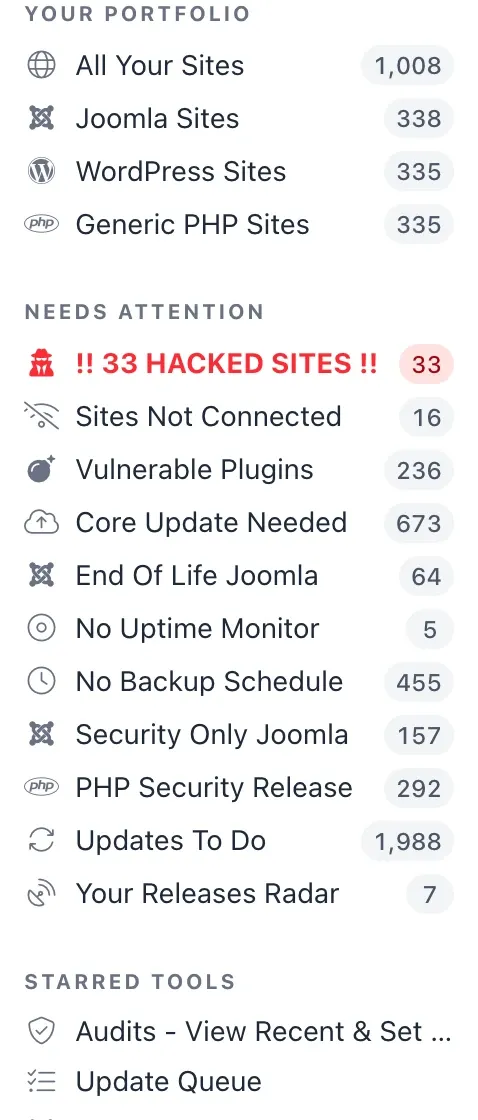
Those two rows split the work in two. Core upgrades for Joomla and WordPress have their own screen, Mass Upgrade Sites, because a core upgrade replaces the files the whole site runs on and deserves its own confirmation. Every Joomla extension, WordPress plugin and WordPress theme update across your sites is on one page: Updates.
One page for every Joomla extension, WordPress plugin and theme update
The Updates page shows one row per site and available update, across the Joomla and WordPress sites on the account. Each row has the extension, its type, the installed and offered version, when that site was last checked, the server it runs on, its flags and its current status. You can group the rows by Extension, Site, Server or Platform, and the grouping is what turns a long list into a plan.
Grouped by Extension, each group header has a changelog link and its own Update all button, so updating Akeeba Backup Professional to 10.0.2 on all the Joomla sites that run it is one click, and reading what changed first is one more. Grouped by Server, you see what is about to hit each host. Grouped by Site, you see what one client is in for. The head of the page shows the queue state (Queue: idle, or Queue: N while work is running), a Re-check all sites button that asks every site for its current offers, and Update all: N, which becomes Update selected: N as soon as you tick a row.
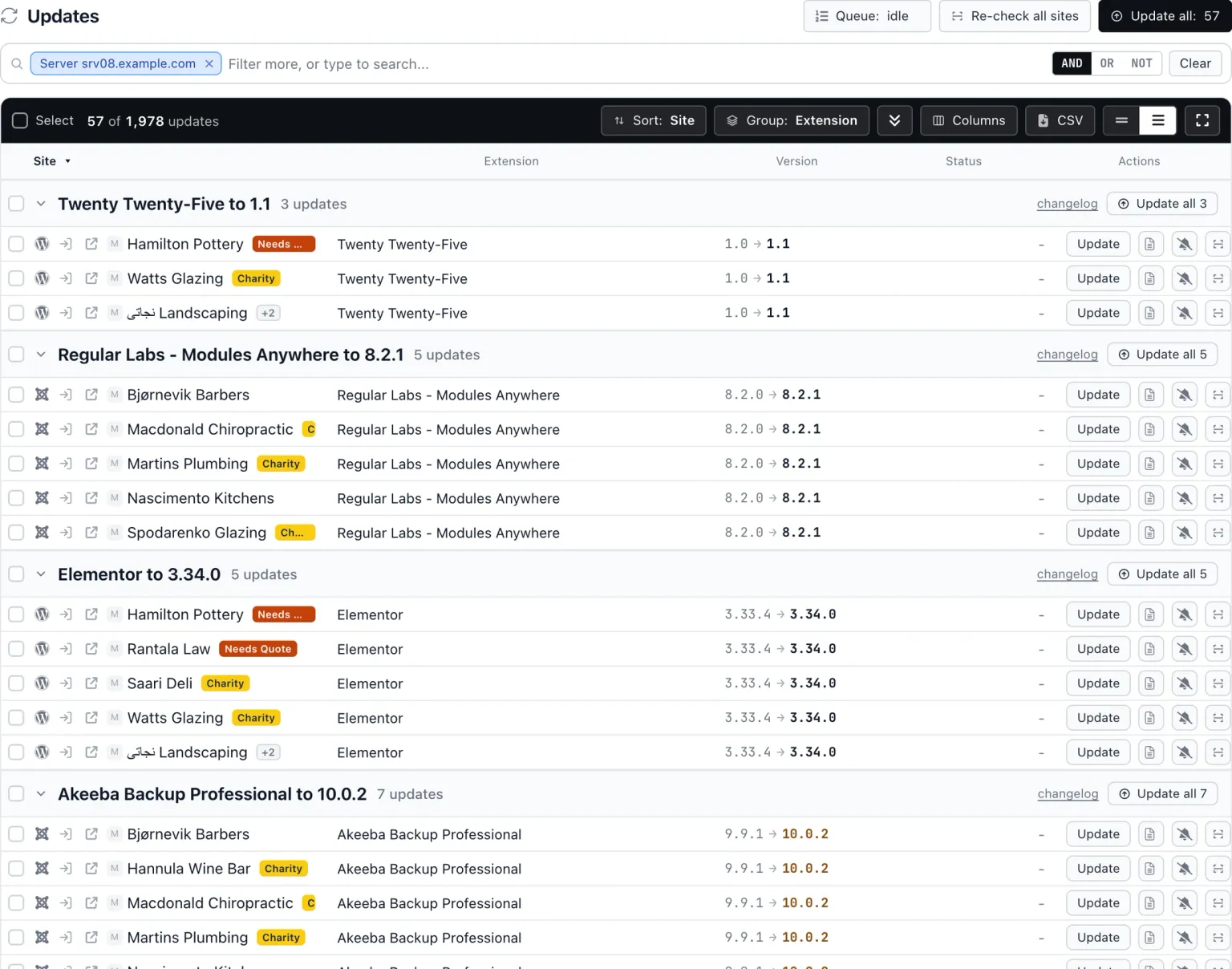
The search box doubles as a filter language. Type a site name, an extension name or a server, or use the tokens: ext:akeeba narrows to one extension across all sites, server: to one host, site: to one site and cms:joomla to one platform. Under the box, the FILTERS list has the quick filters you will use most: Security fixes, Major version jumps, Stale (checked more than 6 hours ago), Failed last time, Queued or updating, Snoozed and Download key missing.
Keyboard users get the same at speed: u updates the highlighted row, r re-checks its site and Shift+U updates its whole group. Tick several rows and the selection bar offers Update, Re-check sites, Remote Install and Snooze. Each row’s menu has Update (which reads Retry after a failure), Snooze, Release notes, Re-check this site, Manage, Visit site and Admin login, and the whole table exports to CSV when a client wants a record of what was waiting.
Rows change state live as the work happens: Queued, then Updating, then Updated or Failed as each site reports back, and you can leave the page at any point. The same table scoped to one site is on that site’s Update tab in Manage Site, with Install new, Check for updates and Update all buttons over an Available updates table with bulk Update and Snooze. The Remote Install button in the selection bar is how you install a Joomla extension or WordPress plugin on many sites at once, which is the other half of the same job.
Security fixes first
The Security fixes filter shows the updates that close a known vulnerability. A row gets a CVE pill, with a tooltip reading “Fixes CVE:” followed by the vulnerability’s title, when the installed version matches one of mySites.guru’s own vulnerability rules and the offered version does not. The flag comes from our rules rather than from the extension developer, which matters because developers do not always say a release is a security release, and some say nothing at all.
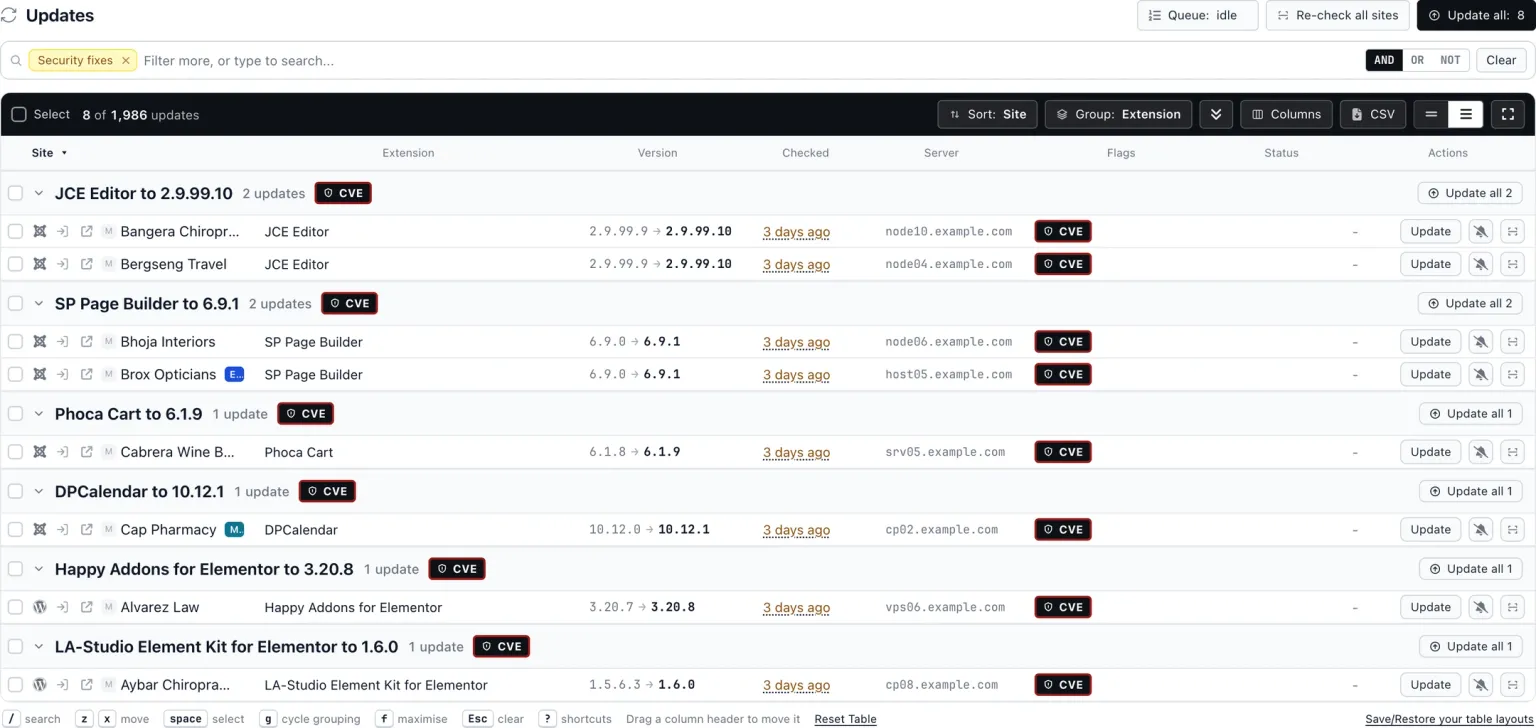
For Joomla extensions those rules are our own database: 379 rules across 218 extensions at the time of writing, published in full on the public vulnerability list. Joomla 5.4.9 and 6.1.4 added a security flag that extension developers can set on their own updates, which helps where they use it, and the vulnerable extension list for Joomla and WordPress covers the rules behind ours. With the Patchstack 5-hour figure in mind, this filter is where every update session should start: take everything it shows, then deal with the rest.
Back up, then update
Click Update all, Update selected or a group’s Update all and a confirmation dialog opens. Its heading states the scope, “Update 8 extensions on 2 sites?”, and under it the per-server lanes the work will run in: “Updates run one at a time per server: web10.example.com: 5 updates, web09.example.com: 3 updates”. Then it offers two ways to proceed. Update 8 queues the updates as they are; Back up, then update does what it says, so each site with Akeeba Backup (Joomla) or All-in-One WP Migration (WordPress) connected takes a fresh backup first, and that site’s updates wait until its backup finishes.
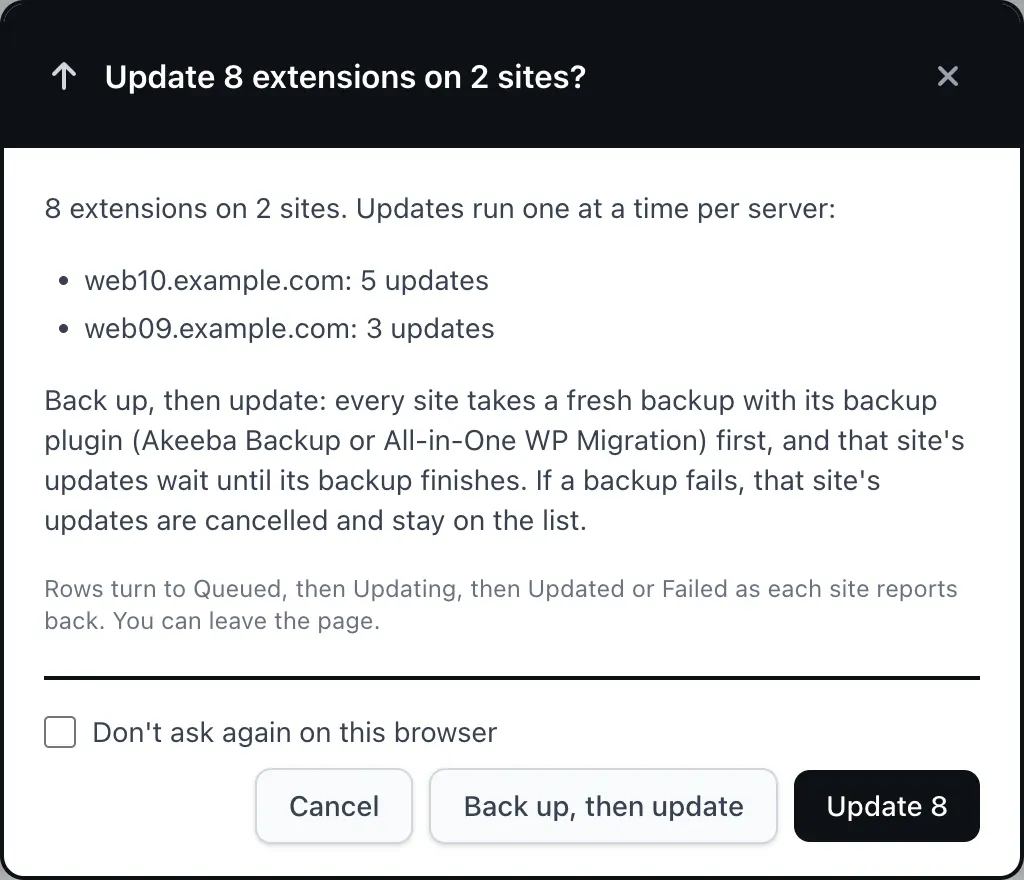
If a backup fails, that site’s updates are cancelled and stay on the list, so no site is updated on the strength of a backup that did not complete. The Back up, then update button only appears when at least one selected site has a backup plugin connected; without one, the dialog offers Update alone, so connect one first. Tick “Don’t ask again on this browser” once you trust the flow.
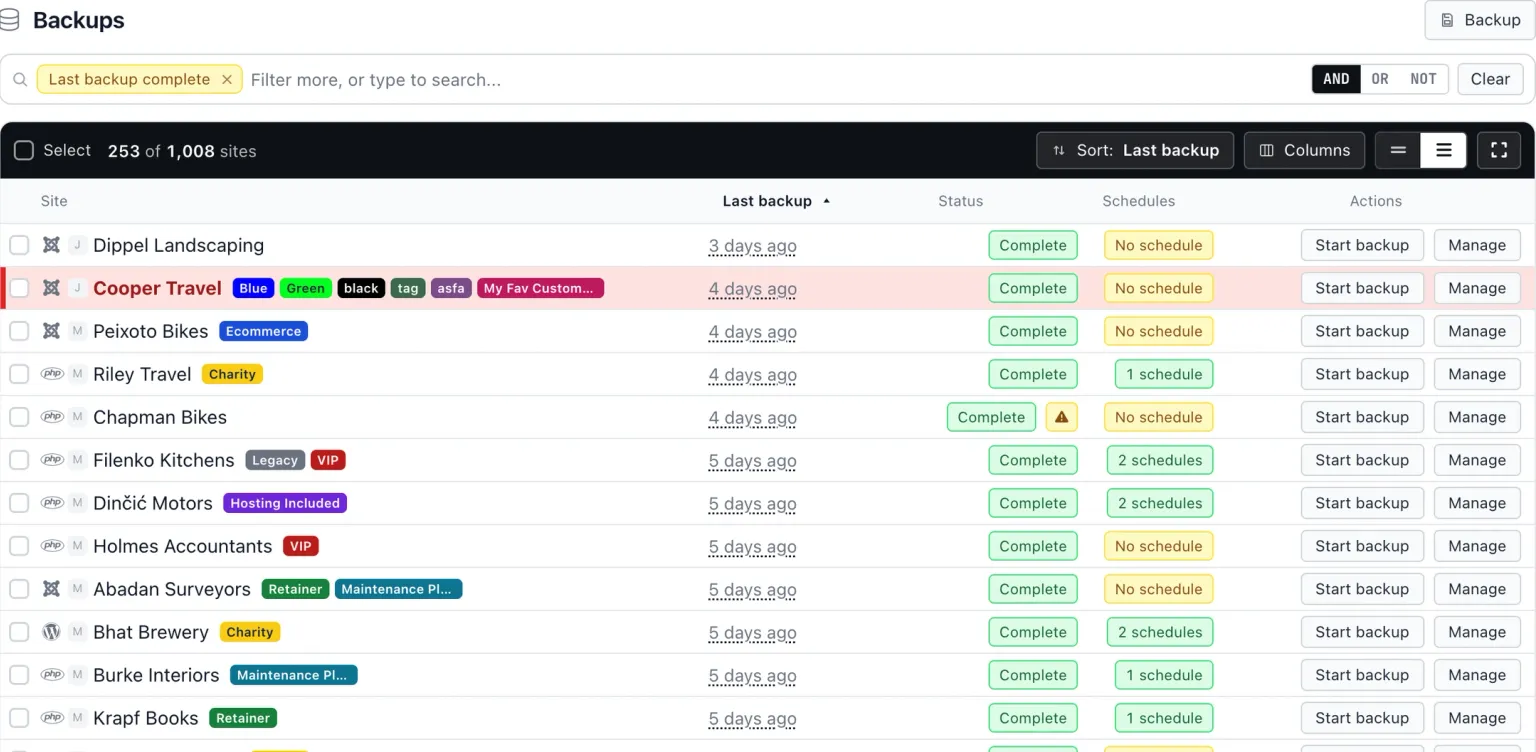
Core upgrades follow the same rule by hand: back up first, test the backup, then upgrade. The Backups page backs up every connected site with one button, and with unlimited backup schedules the nightly backup is usually already there before you start. A backup you have never restored is a file that makes you feel better, so restore one somewhere every so often.
Why do updates queue one per server?
Because twenty sites on one host updating at the same moment is a self-inflicted outage. Every update on every mySites.guru account goes through the Update Queue (Cmd+K, then “u q”), which has one lane per server hostname per account and runs at most one update at a time in each lane. Sites whose hostname is not known share 8 lanes. Updates on different servers run alongside each other; updates on the same server run in order, and that server’s PHP workers and database get one job at a time.
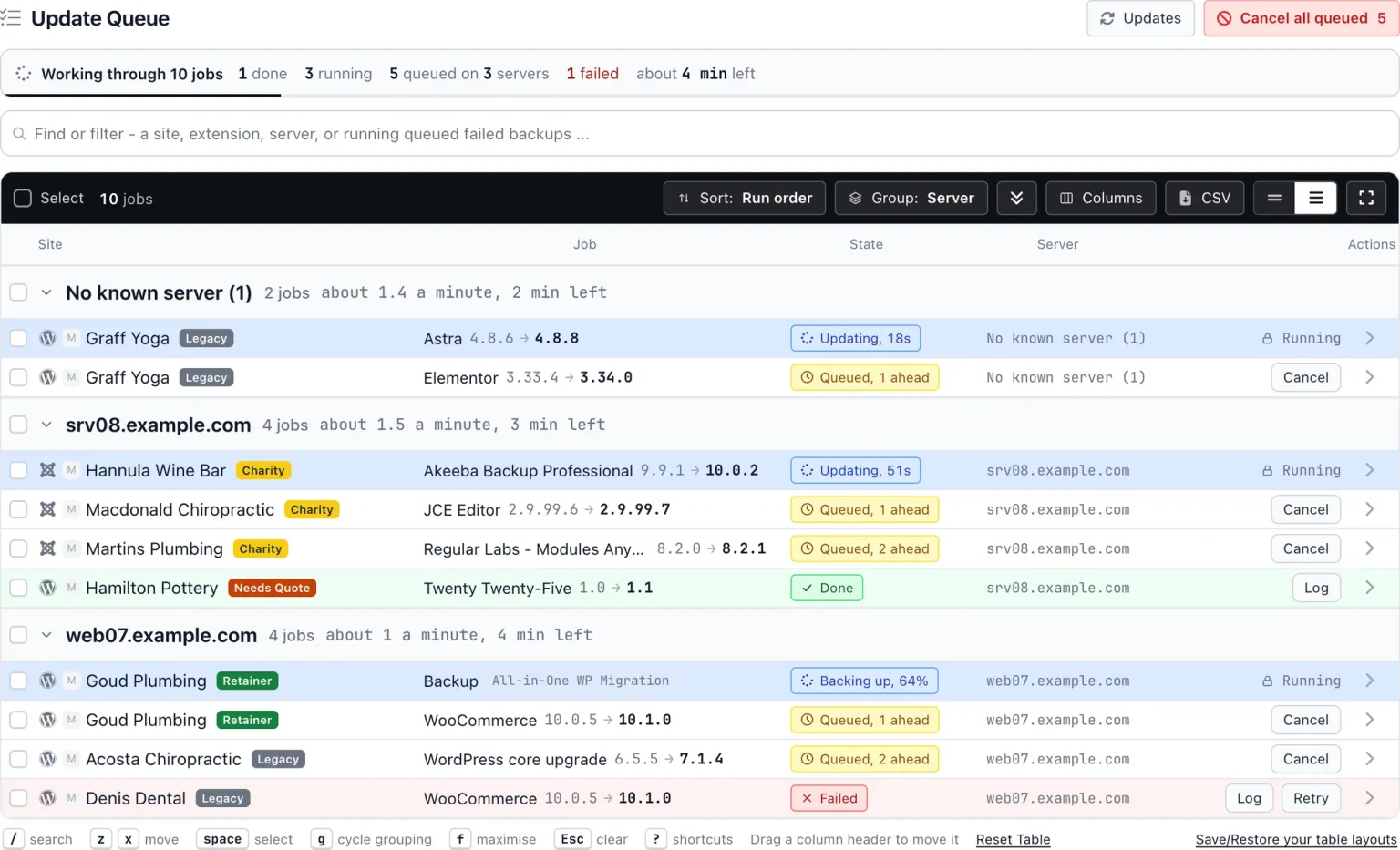
The queue handles four kinds of job: extension, plugin and theme updates, Joomla core upgrades, WordPress core upgrades, and the backups that come first when you chose Back up, then update. Filters for Running, Queued, Failed and Backups, a Cancel all queued button, and Cancel, Retry, Log and Manage on each row are the controls you want when a host is misbehaving. On WordPress there is a second reason for the ordering: WordPress itself runs one update at a time on a site, because each one puts the site into maintenance mode. The post on updates running one at a time per server has the full design reasoning.
Snooze one update, or pause a whole site
Every portfolio has an update that must not happen yet. Snooze is on every row with four presets: Skip this version, For a week, For a month and Ignore on this site. Skip this version is the one to reach for most often, because it hides the version that broke something and comes back by itself when the vendor releases the next one, which is usually the fix. A snooze is per site, with an Undo toast, and the Snoozed filter lists everything being held back with an Unsnooze button on each row.
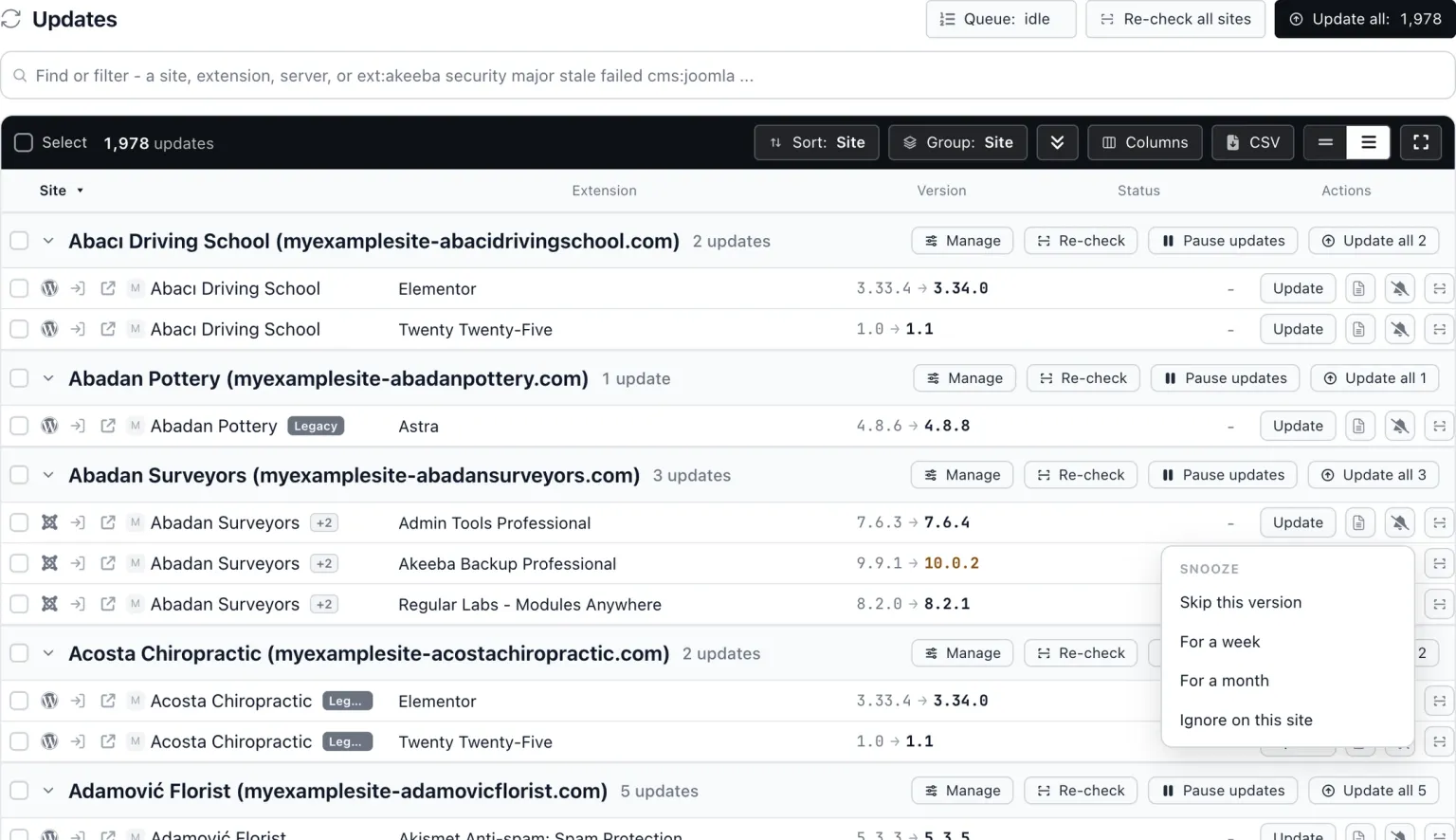
Select several rows and the bulk Snooze adds Ignore on these sites and Pause updates on these sites, so one problem release can be held on all the clients that run it in a single action. What makes this more than a hidden row is enforcement. A snoozed update is skipped by every route: the row Update button, Update all, bulk Update, the API, the MCP tool and Joomla extension auto-updates alike, so no one applies it by accident from another screen.
Pause updates is the per-site switch for a change freeze. It sits in the site’s Config tab under Checks and alerts; the site stays monitored, its updates are still listed, and none are applied until you flip it back. The site’s Updates tab reads “Updates are paused on this site.” The snooze and pause post covers both in detail, including what the API returns for a snoozed update.
Pause Updates on One Site, or Snooze One Joomla Extension or WordPress PluginRead the full post

Pause governs mySites.guru, not WordPress's own cron
A WordPress plugin you have switched to WordPress’s own per-plugin auto-update still updates through WordPress cron while the site is paused. Pause updates stops what mySites.guru applies. If a frozen site must not change at all, turn that plugin’s WordPress auto-update off as well.
How do I upgrade Joomla core on many sites?
The 48-second film below shows a core upgrade across Joomla and WordPress sites together. More short films are on the videos page.
Transcript
A Joomla security release is out. How many of your sites are still behind? Logging in to each one to update it takes all day. Meet Mass Upgrade, in mySites.guru.
Filter your sites to Core update needed, and press Mass upgrade. Check upgrade paths asks each site which version its own updater offers. Tick the Joomla and WordPress sites together, and press Upgrade.
The queue upgrades one site at a time on each server, so no host gets hammered. Each Joomla site shows every stage, from download to database. Every site on the latest release, without opening one admin panel. Mass Upgrade. In mySites.guru.
Filter the sites list to Core update needed and click Mass upgrade. The Core Update Needed list is the same thing the left menu counts: every Joomla or WordPress site behind its latest release, each with a version pill, and a Mass upgrade button that appears with that filter.
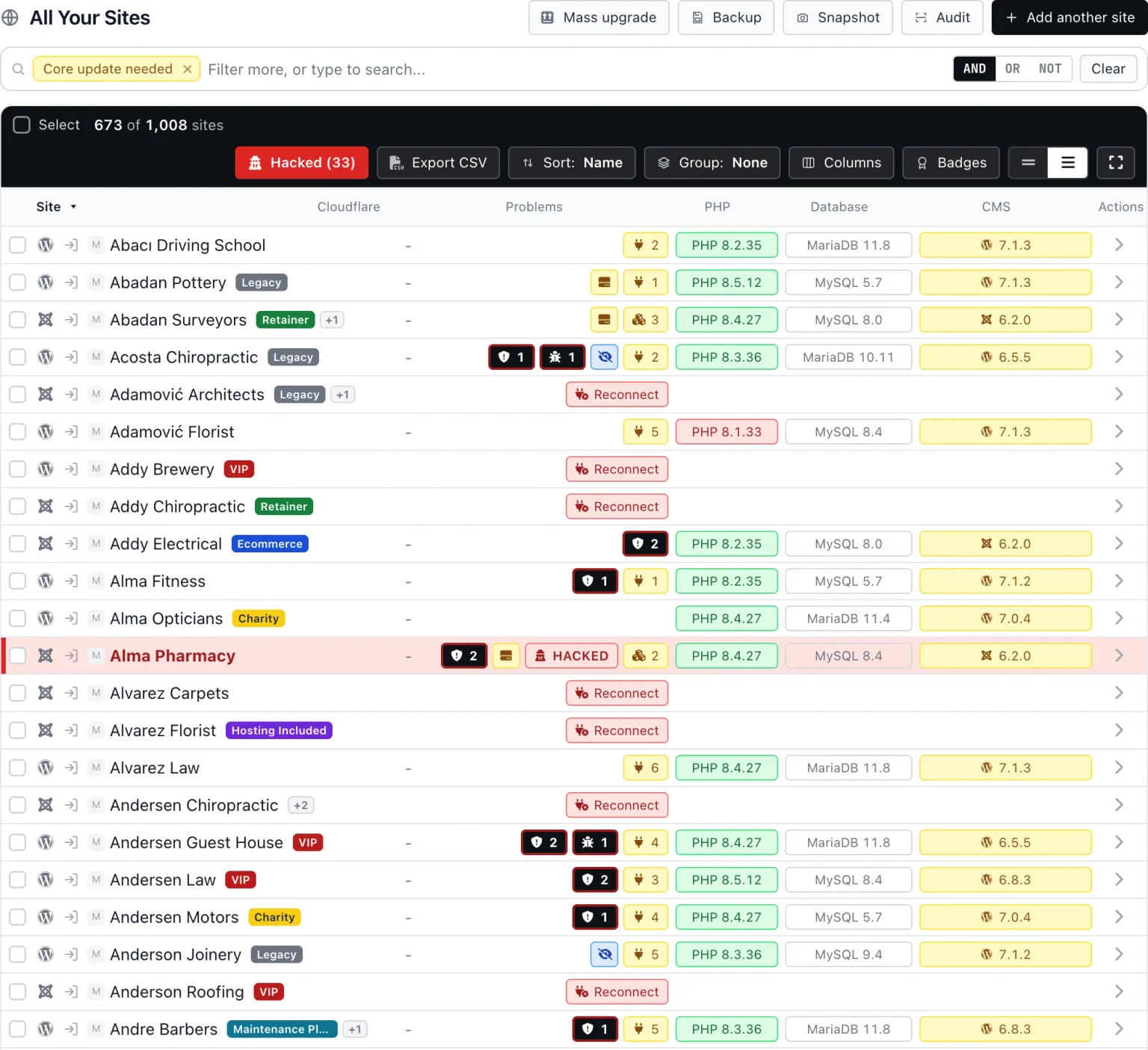
Mass Upgrade Sites first asks each site for its upgrade path (Check upgrade paths, which reads Check again once it has run) and shows four columns: Site, Installed, Offered and Server. Offered is the version each site’s own updater offers, so you see what that site would install for itself. Tick the sites, click Upgrade, and the jobs go into the same per-server queue as everything else, with an Update queue button on the page to watch them. Each job shows its progress through Creating config, Downloading, Extracting and Post-Upgrade Tasks.
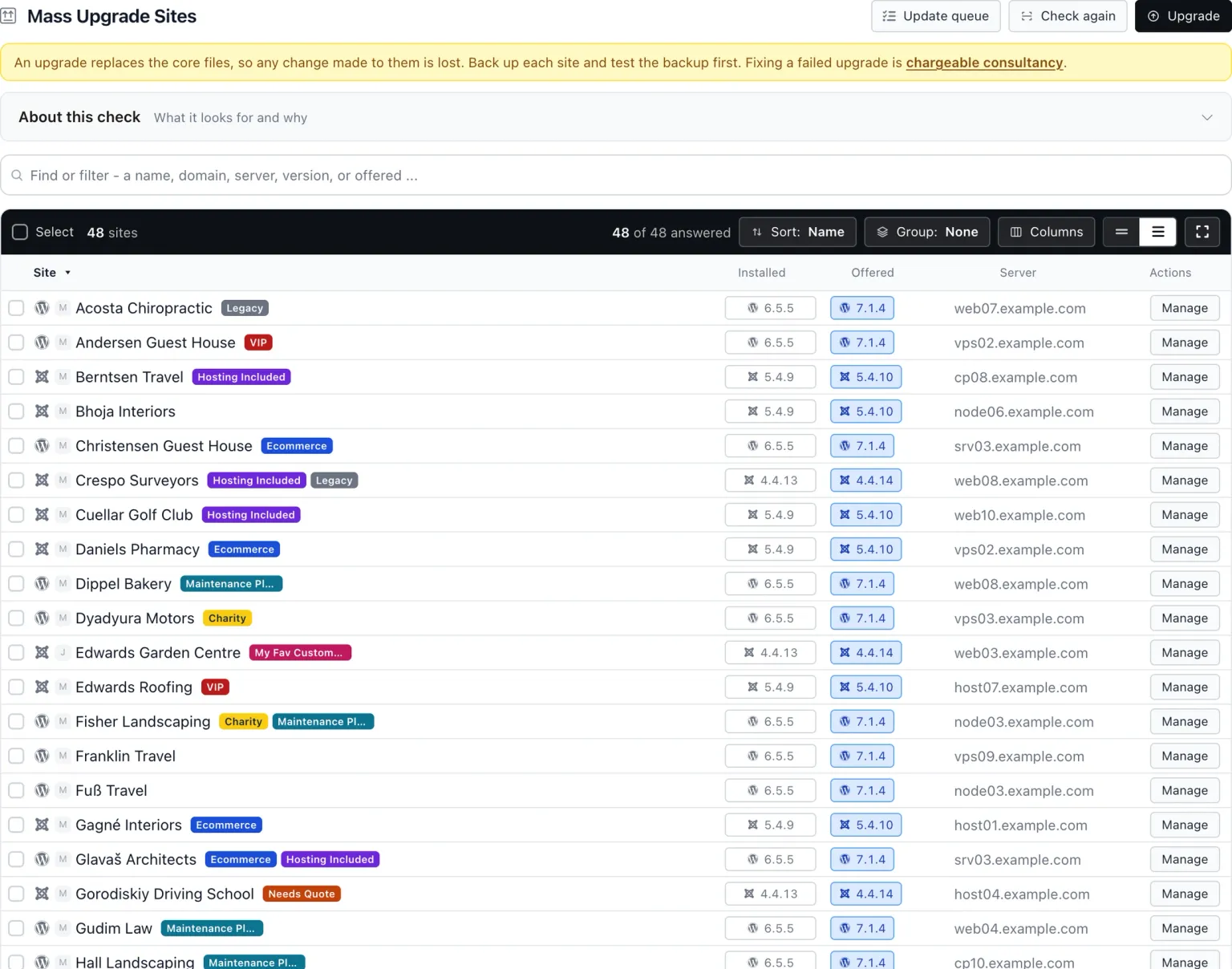
Joomla sites stay inside their current major series. A 4.x site goes to the latest 4, a 5.x site to the latest 5.4.x, a 6.x site to the latest 6.x, and Joomla 3 sites aim at the last 3.10 build, which is what the Joomla 3.10.999 project exists for. A change of major version is a migration with its own compatibility work and is never offered here, and Joomla’s own advice is to be on 5.4 before moving to 6.x. The current targets at the time of writing are Joomla 6.2.0 and 5.4.10, both released on 13 October 2026.
The case for doing this promptly is in the recent record. On 29 September 2026, Joomla 6.1.4 and 5.4.9 fixed 16 core security issues in one release. On 3 October 2026, 26.9% of the Joomla 5.4 sites in the mySites.guru data were still behind 5.4.9, a figure we found while writing up the Joomla 5.4 end-of-support dates.
On a single site, the core upgrade pane in Manage Site shows the PHP version, whether Akeeba is connected, the last backup and any modified core files before you press Start upgrade (Refresh core files re-reads that list). The page notice is worth taking literally: an upgrade replaces the core files, so any change made to them is lost, and you should back up and test the backup first. Joomla sites also have a Config switch, Clean up after core upgrades, that removes the fluff files a Joomla core upgrade leaves behind. The bulk update Joomla page has the Joomla-only walkthrough.
How do I upgrade WordPress core on many sites?
The same way, on the same screen. WordPress sites appear in Mass Upgrade Sites alongside Joomla ones and are offered the latest WordPress release, 7.1.4 at the time of writing, released on 28 October 2026. Tick, Upgrade, and each site’s job queues in its server’s lane. The WordPress 7 requirements post covers what a site needs in place before a major jump like the 6.5.5 to 7.1.4 shown above.
WordPress already does part of this on its own. Minor core releases have auto-updated by default since WordPress 3.7, and major releases have been off by default for existing installs since 5.6. So the WordPress sites waiting in Core Update Needed are often a major version behind, or have had the updater switched off.
mySites.guru’s config checks surface both: whether WP_AUTO_UPDATE_CORE is set to minor-only, and whether AUTOMATIC_UPDATER_DISABLED is on. The posts on enforcing minor upgrades only and stopping WordPress automatic updates in one click cover the two directions you might want, and the bulk update WordPress page is the WordPress-only walkthrough.
Auto-updates: what Joomla and WordPress do on their own, and what mySites.guru adds
Joomla itself has no automatic updates for extensions. From Joomla 5.4 and 6.0 the Joomla Project runs automated core updates for minor, patch and security releases of core only, never for extensions and never across a major version, and you can turn those off from mySites.guru if you would rather pick the moment. WordPress has had per-plugin and per-theme auto-update switches since 5.5, off by default, and since 6.6 a plugin auto-update that causes a fatal error is rolled back, for active plugins and auto-updates only.
mySites.guru fills the Joomla gap with automatic updates for any Joomla extension. In Manage Site, the Auto Update Configuration pane lists each update site with Enable all and Disable all, and a per-row menu with Enable on this site, Enable on all sites, Disable on this site and Disable on all sites. When a snapshot finds a new version for an enabled update site, the update is applied; snapshots run twice a day, so an auto-updated Joomla extension is never far behind its release. It never applies Joomla core, the pane warns that “Backups are your responsibility”, and a snoozed update is still skipped.
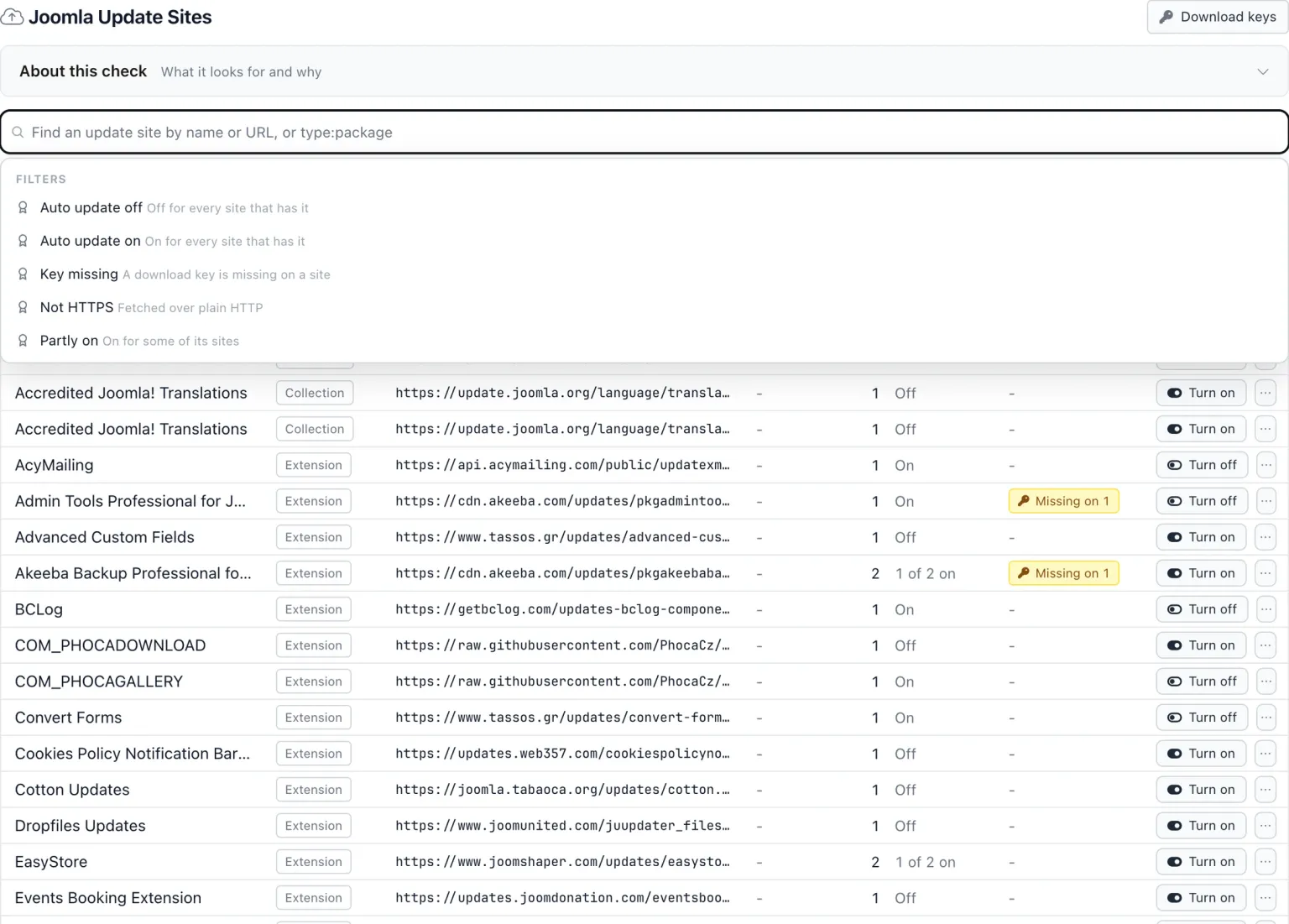
Account-wide, the Joomla Update Sites page lists every extension’s update site with its URL, how many sites use it, its auto update state (On, Off or, say, 1 of 2 on) and a Turn on or Turn off button. Its row menu has Turn on for all, Turn off for all and Set download key, and its filters are Auto update on, Partly on, Auto update off, Key missing and Not HTTPS. The guide to enabling Joomla extension auto-updates walks the same screens more slowly.
For WordPress, the same pane switches WordPress’s own per-plugin auto-update on, for one site or every site, and WordPress then does the updating through its cron. That is the right split: WordPress has a native, rollback-protected mechanism, so mySites.guru controls it across sites rather than replacing it.
Paid extensions and download keys
A commercial Joomla extension will not update without its download key, and keeping one key in forty sites’ update settings is how keys go stale. The Download Keys page saves a key per vendor once and applies it to that vendor’s products across your sites. Keys are encrypted in the database and you only ever see their last four characters afterwards, and only the account owner can write them.
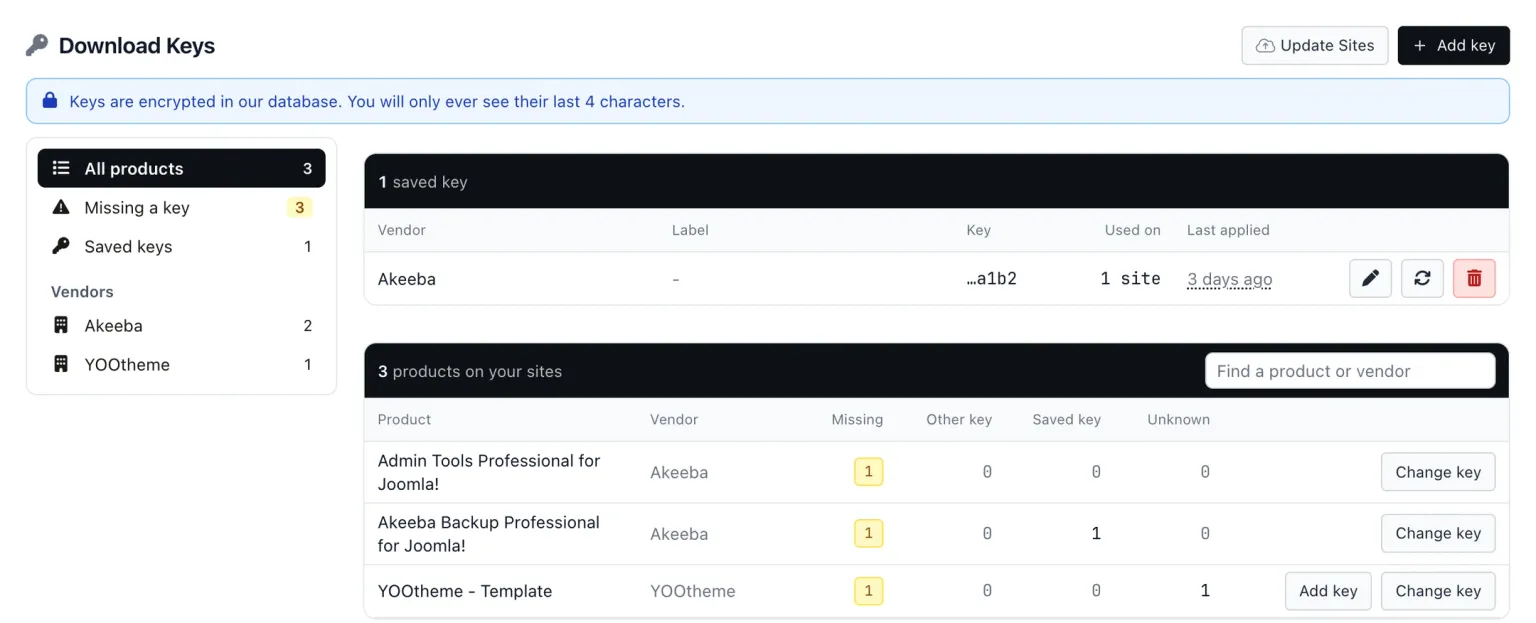
On the Updates page, the Download key missing filter and a Key missing label on a row show where an update is blocked for want of a key, and Key missing opens Set key. This is a Joomla-only feature, because it is Joomla’s update system that asks for the key.
After the run: the log, the alerts and a fresh audit
The Update Log keeps the newest 2,000 update records with the response each site returned. Filters for Failed, Pending, Overnight, By hand and Last 24 h answer the questions you actually ask after a run: what failed, what has not reported back, what the auto-updater did overnight versus what a person clicked. Each row has Response and Retry, and the whole log exports to CSV for a client report.
You do not have to go looking. Three emails are on by default: a successful extension auto-upgrade, an unsuccessful extension auto-upgrade, and a Joomla or WordPress core upgrade that failed. Desktop notifications cover core upgrade failed and finished and update run finished, so a batch you started before lunch tells you when it is done. Upstream of all this, Release Radar watches for new Joomla extension and WordPress plugin releases, so you hear about a release before a client does.
Then verify. Re-check all sites on the Updates page confirms every site now offers nothing, and a fresh audit from the dashboard confirms the sites are healthy after the change.
Updates from the API, Claude and your team
Everything above is available outside the browser, with the same rules. The mySites.guru API lists available updates and triggers them per site:
GET /api/v1/updates
POST /api/v1/sites/{hashId}/extensions/update
The POST returns 202 when the work is queued and 409 when every update you named is snoozed or on a paused site, so a script cannot mistake a skipped update for a success. The MCP tools list_available_updates, trigger_extension_update and list_update_log let you run the same workflow from Claude Desktop. Core upgrades have no API or MCP route; they stay a browser action.
Team members get the same screens with permissions by area, and “Extension updates” and “Core upgrades” are separate areas. A junior can run plugin updates on every client while core upgrades are held to whoever answers for them. The post on managing sites with your whole team has the full list of areas.
A routine that works
Security fixes first. Major versions by hand. Snooze the version, not the extension.
Everything else is a batch.
This is how I run it, and how I would run it for an agency with a few hundred sites.
- Security fixes go the day they appear, ahead of the weekly slot. Open Updates, choose the Security fixes filter, Update all with Back up, then update, and leave the page. The 5-hour exploit figure above is why this step does not wait.
- Major version jumps get the Major version jumps filter and one site first. Read the changelog link on the group header, update one site you can afford to break, look at it, then Shift+U or the group’s Update all for the rest.
- When a version breaks something, Skip this version. Not Ignore on this site, which also hides the fix when it arrives, and not a note in a ticket, which stops no one. The Snoozed filter is the record of what is being held back and why.
- Batch the rest once a week. Group by Server so you can see what each host is in for, Update all, Back up, then update, and check the Update Log’s Failed filter the next morning.
- Core goes through Core Update Needed and Mass Upgrade Sites, within the current series, after the extension batch has settled. Clean up after core upgrades on for the Joomla sites.
- Before any of it, the Stale filter: anything checked more than 6 hours ago gets Re-check all sites first, so you are updating against what the sites offer now.
Most agencies start with whatever is at the top of the list and run out of time before they reach the security fixes buried in the middle. Start with the filter, and the rest of the list can wait a day if it has to.
Every update on every site, on one page
The Updates page shows every Joomla extension, WordPress plugin and theme update across your sites, with security fixes flagged by our own rules.
All of it is part of the subscription
Everything in this post, the Updates page, Back up then update, the per-server queue, snooze and pause, Mass Upgrade Sites, Joomla extension auto-updates, download keys, the Update Log, the API and MCP tools and team permissions, is part of the mySites.guru subscription. The pricing page has the plans, and the free audit is the quickest way to see what a site of yours is currently offering, including the updates it is behind on. For the wider thinking on how to update Joomla and WordPress across a large portfolio, the guide to managing CMS updates at scale sits alongside this post.
Further Reading
- Joomla 6.2 is here - the Joomla Project's release announcement for 6.2.0 and 5.4.10.
- Core major versions auto-updates UI changes in WordPress 5.6 - why major WordPress releases stopped auto-applying on existing installs.
- Plugins and themes auto-updates - the WordPress documentation for the per-plugin switch added in 5.5.
- Merge proposal: rollback auto-update - the WordPress 6.6 change that rolls back a plugin auto-update which causes a fatal error.
- State of WordPress Security in 2026 - Patchstack's figures for 2025, including the 5-hour median time to first exploit.
Frequently Asked Questions
Does mySites.guru update Joomla and WordPress core as well as extensions and plugins?
What happens if an update breaks a site?
How do I skip one update without ignoring the extension?
Does mySites.guru update paid Joomla extensions that need a download key?
What is the difference between Joomla's automated updates and mySites.guru auto-updates?
Can mySites.guru upgrade Joomla 5 to Joomla 6?
 Written and edited by a human, with AI assistance. Our approach to AI