Joomla 6.1.0 Released - What's New
Joomla 6.1.0 stable shipped today, 14 April 2026. First minor release since 6.0 dropped in October 2025, and there are a few things in it worth knowing about.
If you manage multiple Joomla sites, the mySites.guru compatibility checker can confirm all your sites meet the Joomla 6 technical requirements before you start rolling out updates. The tool scans every connected site’s PHP version, database version, and update channel in one view - no logging into 30 different admin panels.
The Three Headline Features in Joomla 6.1
The Joomla project promoted three features as the headline additions for 6.1. None will change your life, but they each fix something that’s been mildly annoying for years.
Visual workflow editor
Joomla’s content workflow system has existed since Joomla 4, but configuring it meant working through form fields and mentally mapping out stage transitions. Joomla 6.1 adds a graphical drag-and-drop editor that lets you visually design workflow stages and transitions. For agencies managing editorial workflows across client sites, this turns a clunky setup process into something you can actually demonstrate to a client in a meeting.
Built-in POW captcha
“POW” stands for proof-of-work. The idea is borrowed from cryptocurrency mining, but applied to spam prevention. When a visitor submits a form, their browser has to solve a small computational puzzle before the submission goes through. The puzzle takes a fraction of a second for a real browser on a real device, but it’s expensive to solve at scale. A spammer trying to submit thousands of forms would need thousands of times the computing power, which makes automated spam economically pointless.
The key difference from reCAPTCHA or hCaptcha: everything happens locally. The visitor’s browser does the work and proves it did, without contacting any external server. There’s no API key to configure, no third-party JavaScript to load, no visitor data leaving the site, and no cookie consent banner needed for the captcha.
For agencies this is useful. Setting up spam protection on a new client site today means registering for a reCAPTCHA account, generating API keys, pasting them into the Joomla admin, and hoping the client doesn’t lose the keys when they change their Google account. Multiply that by 30 or 50 sites and you can see why I’m pleased about this one. With POW you enable a core plugin and you’re done.
It also sidesteps the GDPR question. reCAPTCHA sends visitor data to Google, so you need consent in the EU. POW doesn’t phone home to anyone, so there’s nothing to disclose. Joomla has a strong German contributor base and Germans don’t mess about with GDPR, so I’d guess that’s part of why this exists. Either way, it’s a better default.
For the step-by-step on how to enable it across one site or every Joomla 6.1 site in your portfolio, see how to enable POW captcha in Joomla 6.1.
Media custom fields for audio, video, and documents
The media custom field plugin previously only handled images. In 6.1, it supports audio, video, and document file types. This is useful for sites that need to attach downloadable PDFs, audio clips, or video files to articles through structured custom fields rather than dumping everything into the article body.
The Smaller Wins Shipped Alongside 6.1
A pile of smaller things shipped too.
Modules now have version tracking - something articles have had for years. If you’ve ever lost a module change and wished you could roll back, this finally fixes that. I wrote up how to turn module versioning on manually and across every site at once. Modules also gain association support across languages.
The default Cassiopeia template’s child now includes built-in colour and font-size customisation without needing custom CSS. Clients can adjust brand colours directly from the template settings panel. The Joomla Community Magazine wrote about this when it first shipped - worth a read if you’re tired of writing CSS overrides for every client.
All plugins (except compatibility plugins) now load lazily, which should reduce memory usage on sites with many plugins installed. MFA enforcement has been tightened too - administrators can now force or exempt multi-factor authentication for superuser accounts specifically, which matters for agencies where multiple team members share admin access. That is a bigger change than it sounds: until 6.1 the Super Users group was filtered out of the field entirely, so forcing MFA on Super Users was not something anyone could switch on.
Some smaller wins: tags can be copied and moved in batch (finally), TinyMCE can handle <abbr> elements for accessibility, subforms get a grid layout option that looks cleaner on mobile, and there’s a new CLI command to enable/disable extensions from the command line.
The language override view now shows status and lets you quick-create missing overrides, which saves a lot of scrolling. The API picks up Schema.org data integration for anyone building headless Joomla sites. And for developers: the Web Asset Manager now supports a nocache version string in joomla.asset.json, which forces cache-busting during development so you stop wondering why your JS changes aren’t showing up.
What Should Joomla Agency Owners Do About 6.1?
If you’re managing client sites, don’t just hit “update all” and hope for the best.
-
Check compatibility. Use the mySites.guru Joomla 6 compatibility tool to review your sites’ PHP and database versions. Joomla 6.1 has the same requirements as 6.0 (PHP 8.3+, MySQL 8.0.13+/MariaDB 10.4+), so if your sites are already on 6.0, you’re clear.
-
Verify update channels. Make sure production sites are on the Default update channel, not “Joomla Next”. The Default channel delivers minor updates like 6.0 to 6.1 safely. See how to prevent accidental Joomla version jumps if you haven’t set this up.
-
Check automated updates. Joomla 5.4 introduced automated core updates that can apply patches without admin intervention. If you prefer to control when updates happen, disable automated upgrades before 6.1 rolls out to your sites.
-
Test on one site first. Pick a low-risk client site, apply the update, check that templates and extensions work, and review any overrides the update changed. You can compare template versions across your portfolio to spot inconsistencies. Pay attention to any custom child templates - Joomla 6.1 changed how child templates handle language files (they now extend rather than override), which could affect custom translations.
-
Roll out in batches. Once you’re confident, use the mySites.guru bulk update tool to push the update across your remaining sites from one dashboard.
Technical Requirements Are Unchanged From 6.0
No. The minimum requirements are identical to Joomla 6.0:
| Requirement | Minimum | Recommended |
|---|---|---|
| PHP | 8.3.0 | 8.4+ |
| MySQL | 8.0.13 | 8.4+ |
| MariaDB | 10.4.0 | 12.0+ |
If your server already runs Joomla 6.0, no infrastructure changes are needed for 6.1. For a deeper look at these requirements and what they mean for your hosting, see the full Joomla 6 technical requirements breakdown.
Are There Breaking Changes in Joomla 6.1?
A few things to watch for:
- Child template language files now extend parent language files instead of overriding them. If you’ve customised language strings in a child template, check they still apply after the update. This is the one most likely to bite you.
- The deprecated dispatcher usage and OPTGROUP handling have both been removed. Extensions still using the old patterns may break.
- Plugin lazy loading is now the default. Compatibility plugins are excluded, but custom plugins that assumed a specific loading order may need adjustment.
Extension developers should review the migration guide for the full list.
Known issues shipping with 6.1
There’s at least one known bug that made it into the stable release: if you enable Debug System in Global Configuration and set Query Explains to “Show” in the Debug plugin, all AJAX calls on the admin dashboard will fail with 500 errors (#47526). This has been present since RC1 with no fix attached yet. If you use debug mode on production (you shouldn’t, but people do), leave Query Explains turned off until a 6.1.1 patch ships.
There’s also an open draft PR to harden WebAuthn unserialize calls against PHP object injection - a security fix that didn’t make the 6.1.0 cut but should arrive in a patch release soon.
Joomla.org Got a Redesign Alongside the Release
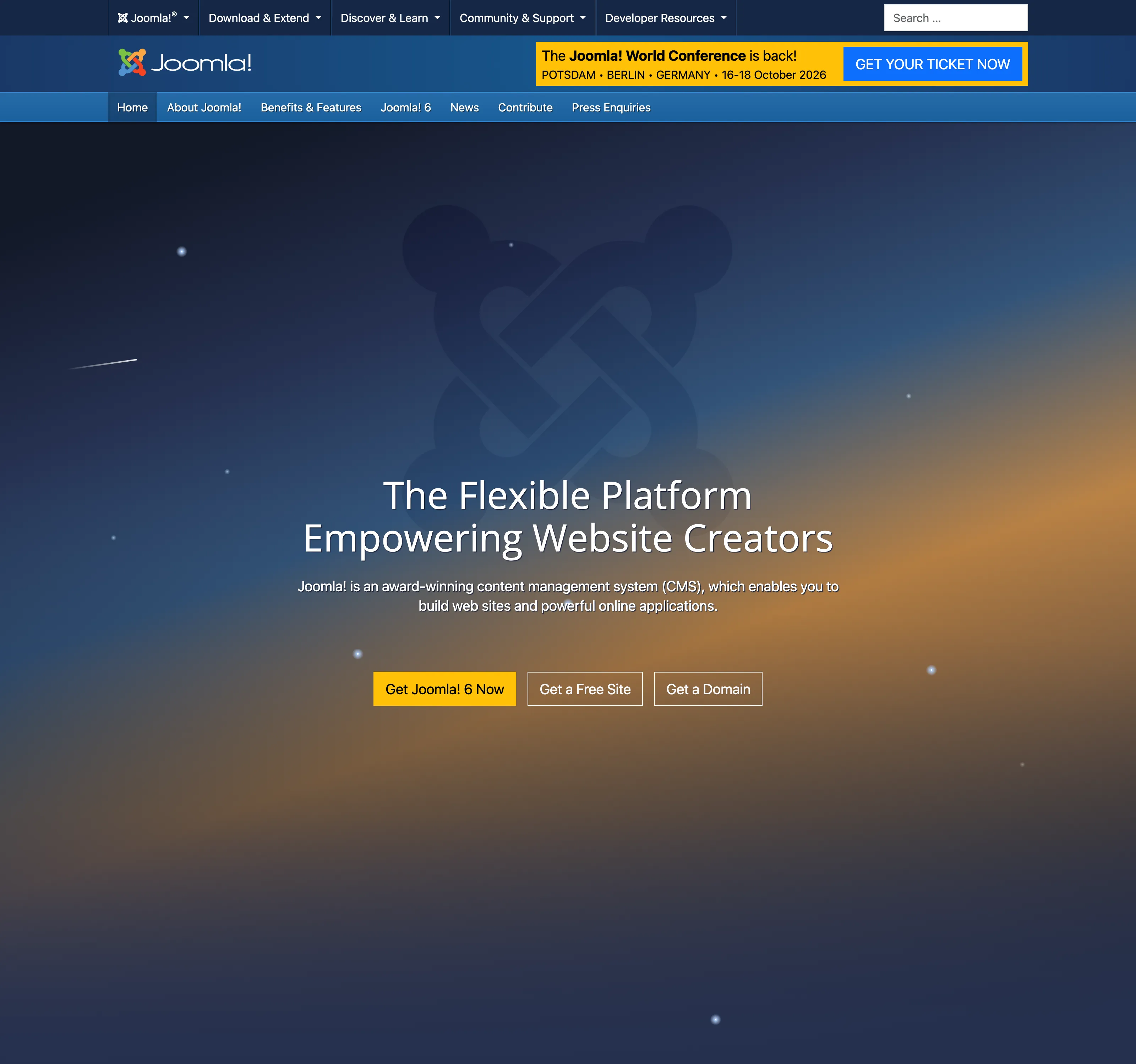
Yes. Alongside the 6.1 release, joomla.org has had a facelift. The homepage now uses the same design language as 6.joomla.org, with a layout and typography that finally match the CMS it’s selling. Trying to convince a client that Joomla is a modern platform is a lot harder when the project’s own homepage looks like it was built in 2018, so I’m glad to see this one happen.
What Features Were Planned for Joomla 6.1 but Didn’t Make It?
The Alpha 1 announcement mentioned several features “in development” that didn’t make the cut. I dug into the current status of each one:
- AI integration via MCP servers - A proof-of-concept was built during a January 2026 sprint by four core contributors, but it still needs cleanup, installation scripts, and tests before it’s PR-ready. There’s no open PR in joomla-cms yet and no confirmed version target. Don’t hold your breath for 6.2.
- Rate-limiting framework - This one has been explicitly pushed to Joomla 7.x (2027+) on the official strategy page. It’s not coming in any 6.x release.
- Health checker tool - The project exists in the
joomla-projects/HealthCheckerrepo but hasn’t been merged into core. No PR targeting joomla-cms has been opened. If you want a health checker now, Joomla Health Checker is free, or mySites.guru gives you deeper insights across all your sites. - Full WCAG 2.2 AA compliance - Listed as “in planning” on the features tracker with no version assigned. There are a few incremental accessibility PRs targeting 6.2 (aria-disabled for toolbar buttons, admin sidebar improvements, alt text for language module images), but nothing close to a comprehensive WCAG 2.2 sweep.
Joomla 6.2 is scheduled for 13 October 2026, with Alpha 1 on 26 May 2026. Based on the PR activity, expect incremental improvements rather than any of these headline features shipping. The release candidate is now out, and our Joomla 6.2 requirements and readiness guide covers what made it in.
Joomla 6.1 Release Timeline
The full development cycle from first alpha to stable took five months:
| Milestone | Date |
|---|---|
| Alpha 1 | 25 November 2025 |
| Alpha 2 | 23 December 2025 |
| Alpha 3 | 20 January 2026 |
| Beta 1 (feature freeze) | 17 February 2026 |
| Beta 2 | 3 March 2026 |
| Beta 3 | 17 March 2026 |
| RC 1 | 31 March 2026 |
| RC 2 | 7 April 2026 |
| RC 3 | 13 April 2026 |
| Stable | 14 April 2026 |
Feature freeze at Beta 1, then three months of stabilisation. The project has settled into a predictable six-month minor release cadence, which makes planning client upgrades much easier.
What About Sites Still on Joomla 5?
Joomla 5.4.5 shipped the same day as 6.1, a bugfix release for the 5.x series with 12 merged pull requests. Nothing headline-grabbing, but a useful cleanup pass:
- Prevents recursion in the loadposition and loadmodule plugins
- Fixes a double timezone conversion in Media Manager file dates
- Corrects RTL/LTR corner radius inconsistencies
- Resets the media manager rotate angle input properly
- Improves TinyMCE custom CSS loading
- Fixes a custom fields regex pattern in ShowOnRule
- Highlights modal category field validation correctly
- Warns about duplicate subform fields
- Corrects an association template file path
Joomla 5 is still under active maintenance, so if you have clients who aren’t ready to move to 6.x yet, 5.4.5 is a safe maintenance update. Grab it from downloads.joomla.org or let mySites.guru push it across your portfolio in one go. Joomla then followed up on 26 May 2026 with a joint 5.4.6 and 6.1.1 security release covering ten CVEs including an MFA bypass and a com_users privilege escalation, so anything still on 5.4.5 or 6.1.0 needs that patch next.
Further Reading
- Joomla 6.1 official release notes - the full changelog and download links
- Joomla 6.1 new features documentation - official feature details with code examples
- Joomla 6.0 to 6.1 migration guide - breaking changes and developer notes
- Joomla project roadmap - what’s planned for 6.2 and beyond
- Joomla 6 technical requirements - official minimum and recommended versions
Planning your Joomla 6.1 rollout? The Joomla Agency Handbook covers update strategy, version management, and multi-site workflows.
Frequently Asked Questions
What are the headline features in Joomla 6.1?
When was Joomla 6.1 released?
Does Joomla 6.1 change the minimum PHP or database requirements?
How can I check if my Joomla sites are ready for 6.1?
What is the Joomla 6.1 POW captcha?
When is Joomla 6.2 expected?
Does mySites.guru support Joomla 6.1 sites?
 Written and edited by a human, with AI assistance. Our approach to AI