PageBuilder CK File Upload RCE - June 2026

PageBuilder CK is one of the more popular free page builders for Joomla, a drag-and-drop layout tool that thousands of sites lean on for their landing pages and content. On 27 June 2026 its developer, Cedric Keiflin, released version 3.6.0 with a changelog that says, in full, “IMPORTANT : Fix security issue”, with no further detail. That terse line is hiding a serious one.
In every version up to and including 3.5.10, PageBuilder CK has an unauthenticated file upload flaw that leads to remote code execution. An attacker with no login can upload a file to your Joomla site, choose which folder it goes in, and then run it. That is full control of the site: stealing data, defacing pages, planting backdoors, or using your server to attack other people. We confirmed it by comparing the old and new code and reproducing the whole chain on a clean test install.
The fix is PageBuilder CK 3.6.0. If any of your Joomla sites run this component, update them now, then read on for what the flaw does and how to check whether you were already hit.
Update, 27 June 2026: this is now being exploited in the wild. Within hours of the fix being released, our suspect content tool flagged a live web shell on a connected Joomla site, planted through this exact flaw. The file sat at /media/com_pagebuilderck/gfonts/bhup.php, an upload handler that runs whatever an attacker POSTs to it. The fix came out on 27 June 2026 and the attackers were not far behind, so if you run PageBuilder CK below 3.6.0, treat this as urgent: update now, then check for compromise. Every affected site is already flagged on the new Important tab, and the suspect content tool is actively catching shells like this one (see below).
Update, 17 August 2026: 3.6.0 fixed this flaw, but it did not fix it completely, and two more security issues followed it. The 3.6.0 release added the missing permission check without correcting the upload handler behind it, so any Editor account could still upload and run a PHP file up to 3.6.2 (CVE-2026-63048, fixed in 3.6.3). A separate SQL injection in the styles handling then took two attempts to close, and is fixed in 3.6.5 (CVE-2026-74254). If you are here to remediate, the version to be on is 3.6.5, not 3.6.0. We pulled the whole sequence apart in PageBuilder CK RCE fixed, again, correctly this time.
TL;DR
- Unauthenticated arbitrary file upload to remote code execution in PageBuilder CK, a free Joomla page builder. No login required
- Worse than a typical upload bug: the attacker chooses the destination folder, so a planted file can end up anywhere on the site, including outside any images directory
- Affects every version up to and including 3.5.10. Fixed in 3.6.0 for current Joomla, released 27 June 2026. The vendor also back-patched the older lines: 3.1.1 for Joomla 3 and 3.4.10 for Joomla 4, so match the patched version to the Joomla version your site runs
- The only thing in the attacker’s way is a CSRF token, which any visitor can read straight off the site’s own pages. That is not a security barrier
- Tracked as CVE-2026-56290, CVSS 10.0 (critical), published 29 June 2026 and crediting Phil Taylor of mySites.guru as the finder. The vendor changelog reads only “IMPORTANT : Fix security issue”
- We confirmed it by source-diffing 3.5.10 against 3.6.0 and reproducing the upload-to-execution chain on a clean Joomla 5 install. We are not publishing a working exploit
- Update to 3.6.0 on every affected site, then check for compromise. Unpublishing the component does not protect you
The fix is out, but the longer a site stays on an old version, the more time automated scanners have to find it. Bots work through lists of Joomla sites looking for exactly this kind of flaw, and your site does not need to be a target to get caught. Update to 3.6.0 before you do anything else.
How to Find Every Joomla Site Running PageBuilder CK with mySites.guru
When a flaw is disclosed in a component that could be on dozens of your client sites, the first question is always the same: which of my sites run it, and on what version? If you manage 50 or 200 Joomla sites, logging into each admin to check the PageBuilder CK version is not realistic. The bots do not wait for you to finish the list.
mySites.guru records the exact version of every installed extension across every connected Joomla site on a twice-daily snapshot. The extension search shows you every site running PageBuilder CK, grouped by version, in seconds. Filter for anything below 3.6.0 and you have your work list.
View all your PageBuilder CK installations
Open PageBuilder CK Extension Search
Lists every installed version across all your connected Joomla sites. Filter for anything below 3.6.0 to find the installations that need updating.
Combined with the mass extension updater, you can push 3.6.0 across every affected site in one batch instead of a day of logging into admin panels one at a time. What would have been a frantic afternoon becomes a triage you finish over a coffee.
If you do not have a mySites.guru account yet, start a free month and connect your sites. The extension index builds automatically on the first snapshot, and you will know straight away which sites are exposed.
What the Bug Actually Did
PageBuilder CK does its work through a set of front-end endpoints, the kind of background requests a builder makes while you drag elements around and save your layout. One of those endpoints handles file uploads, for adding images to a page.
The problem is what that endpoint did not check. Before a site does anything sensitive, it should ask two separate questions: who is this (authentication), and are they allowed to do this (authorization). The upload endpoint asked neither. The only thing it checked was a Joomla anti-CSRF token, a value meant to confirm a request came from a real page on the site rather than being forged from somewhere else. A CSRF token is not a login. It does not prove who you are, and it does not prove you have permission. And because Joomla prints that token into its own public pages, any visitor can grab one in a single request.
So a guest, with no account and no session, could reach the upload code. That alone would be bad. Worse, the endpoint took the destination folder straight from the request and the filename, including its extension, exactly as supplied. There was no allow-list restricting uploads to images, no block on PHP files, and no confinement to a media directory. The caller picked the folder, and the caller picked the file.
Put those together and the attack writes itself. Upload something.php into a web-served folder, then load that file in a browser, and the server runs it. That is remote code execution, the most severe class of web vulnerability there is, reachable by anyone on the internet.
A note on what we are not publishing. We confirmed this flaw by comparing the old and new code and reproducing it on our own test install, and we reported nothing that is not already implied by the public fix. We are not naming the exact endpoint or sharing a working request. The fix is out, and the responsible thing is to get people patched, not to hand a recipe to the next scanner, although with AI help they could replicate what we did in seconds.
Now Being Exploited in the Wild
When we first published this, we had reproduced the flaw ourselves but had not seen it used against a real site. That changed within hours. Our suspect content tool flagged a live web shell on a connected Joomla site, dropped in through this exact upload flaw.
The file was here:
/media/com_pagebuilderck/gfonts/bhup.phpIt is a small uploader shell. The giveaway line is this:
if( $_POST['_upl'] == "Upload" ) {That is a self-contained file manager: load the shell in a browser and it shows an upload form, then writes whatever you hand it anywhere on the server it can reach. The attacker used the PageBuilder CK flaw once to plant a permanent door, and from then on did not need the flaw at all. This is the standard pattern: the first upload is a foothold, not the payload.
Two things to take from where this one ended up. It sits under /media, not the /images folder people usually watch, which is the whole reason “just lock down /images” does not work against a flaw that lets the attacker pick the folder. And it hides inside gfonts, a plausible-looking subfolder name that blends in with legitimate font assets. If you are checking your own sites by hand, do not just scan the obvious upload directories, and do not assume a folder is safe because its name looks innocent.
What to look for. On any Joomla site that has run PageBuilder CK below 3.6.0, search for stray .php files under /media/com_pagebuilderck/ and its subfolders (we found one in gfonts/), and more broadly for any PHP file containing an upload handler like $_POST['_upl'] anywhere it should not be. Finding the shell means the site was compromised: updating to 3.6.0 closes the flaw but does not remove a door that is already in place. Clean the site properly and rotate your Joomla passwords and secrets.
On connected sites you do not have to go looking by hand. The suspect content tool caught this one automatically, which is exactly how we knew the flaw had gone from theory to active use. Anything it flags in a site’s Hacked? section should be treated as a compromise until proven otherwise.
Why “Just Block /images” Is Not Enough
The instinct with an upload flaw is to stop PHP files from running in the upload folder. For a lot of vulnerabilities that is a reasonable stop-gap. Here it is not, because the attacker is not limited to the upload folder. They name the destination in the request, so if you lock down one folder they simply write to another. In our testing the same upload reached and ran in several different directories, and a planted file could just as easily sit among legitimate admin files where you would never think to look for it.
This is why the answer is the update, or, if you cannot update for a few hours, blocking the vulnerable request at a web application firewall or reverse proxy so it never reaches the component at all.
Server-level hardening helps, but know what it does and does not do. If you run Akeeba Admin Tools, its .htaccess Maker will not stop the upload itself, because the write happens inside the component, below the level .htaccess sees. What its long generated .htaccess does do is disable PHP execution in a list of directories, so a dropper that ends up in one of those folders cannot be run by requesting it directly. That neutralises a good chunk of the risk. The catch is that the Maker leaves exceptions where PHP needs to run, and since this flaw lets the attacker choose any folder, those exceptions are exactly where a working shell could still end up. Helpful, then, but not a substitute for the update. A single .htaccess rule scoped to one folder gives an even falser sense of safety against a flaw that can write anywhere.
How to Fix the PageBuilder CK Hack with mySites.guru Easily
Updating is the priority and it is straightforward. In each site’s Joomla admin, go to System then Update then Extensions, find PageBuilder CK, and update it to 3.6.0 or newer. If the update does not appear there, download the latest build from joomlack.fr and install it over the top. If you run more than a handful of sites, push the update across all of them at once from your mySites.guru dashboard rather than working through admin panels one by one.
Then check for a break-in, because updating stops the next attempt but does nothing about one that already happened. Look for PHP files that should not exist, and do not only look in the obvious places. Because this flaw lets the attacker choose the folder, a web shell could be sitting in /images, /media, /templates, /administrator, or anywhere else writable. While you are in the Joomla admin, check your Users list for any Super User accounts you do not recognise and remove them. If you find anything, clean the site properly, change your Joomla passwords and secrets, and run a full security audit across the whole site rather than just the file you found. Whoever gets in through one hole usually leaves a second one somewhere quieter.
mySites.guru helps with the detection half too. Its suspect content tool runs on every audit of every connected Joomla site and flags known web shell signatures and files that do not belong. If a site shows a threat in its Hacked? section, treat it as compromised and work through the cleanup.
This Keeps Happening to Joomla Components
PageBuilder CK is not an outlier. It joins a steady run of third-party Joomla component flaws we have written up this year, and several share the exact same shape: an endpoint that should have been locked down, reachable without a login, doing something dangerous. The SP Page Builder zero day from a different vendor was another unauthenticated upload in a page builder, used to plant hidden Joomla admins. The iCagenda zero day was another unauthenticated file upload. The Novarain framework RCE was unauthenticated code execution in a widely-installed extension. The vulnerable JCE editor was, again, a file upload reached without proper checks. And Helix Ultimate 2.2.7 closed the same class of gap in JoomShaper’s template framework, where unprotected com_ajax actions allowed an unauthenticated menu write that leads to stored cross-site scripting. Balbooa Forms was another one: its frontend attachment upload accepted a file from anyone with no login and no file-type check, so a .php upload could be run as code.
The thread running through all of them is the one we pulled on at length in AJAX endpoints are a big CMS security blind spot: a front-end endpoint that verifies a CSRF token and then stops checking, never asking whether the person behind the request is logged in or allowed to do what they are asking. PageBuilder CK is a textbook case of it, and the 3.6.0 fix is, in essence, adding the permission check that should have been there all along. When a framework leaves authorization up to each individual extension developer, the same mistake gets made independently, over and over.
Joomla’s core team has started closing that gap from their side. The recent updates Joomla 5.4.4 and 6.0.4 hardened the core com_ajax component, which for years let AJAX handlers in the administrator application be called without an authenticated session. From those versions on, Joomla blocks that by default, and a developer who needs an open handler has to opt in explicitly. It is an intended backwards-compatibility break, made because the safe default was worth more than never breaking anything. It will not retroactively fix a component like PageBuilder CK, whose vulnerable code ran on the public site and did its own routing rather than going through core com_ajax, so you still need the 3.6.0 update. But it does mean one large, long-standing version of this mistake is now closed at the source. Keeping your sites on a current Joomla version is part of staying ahead of the next one.
The lesson is not “stop using extensions”. Extensions are what make Joomla useful, and PageBuilder CK is good at its job. The lesson is that the security of your sites rests on code other people wrote and release on their own schedule, and the day a flaw like this becomes public you need to know, within minutes, which of your sites run it, patch them all at once, and check whether any were already turned into a foothold. That is the whole reason mySites.guru indexes every extension on every site you connect. When the next one drops, and there will be a next one, you want to be the operator who patched and swept before the scanner came back, not the one finding a strange admin account three weeks later.
The March 2026 Wave That Made the Pattern Obvious
If PageBuilder CK felt like a one-off it would be easy to shrug at. It is not. In a single month, March 2026, at least five separate AJAX and API vulnerabilities were disclosed across Joomla and WordPress, all sharing the same root cause: an endpoint that checks a token but never checks who is calling it. We pulled all five apart in AJAX endpoints are a big CMS security blind spot; here they are at a glance.
- Astroid Framework for Joomla (CVE-2026-21628, CVSS 10.0). The AJAX endpoint verified a CSRF token but never checked the requester was an administrator. Attackers grabbed the token off the public login page and uploaded backdoors. No login required, and a maximum 10.0 score.
- Novarain / Tassos Framework for Joomla (CVE-2026-21627, CVSS 9.5). Fully unauthenticated, no token and no capability check at all. Joomla’s
com_ajaxrouted requests to the plugin, which whitelisted file inclusion as a non-admin task, allowing arbitrary PHP inclusion, file deletion and SQL injection. - Smart Slider 3 for WordPress (CVE-2026-3098, CVSS 6.5). The export AJAX actions had a nonce but no capability check, so any subscriber-level user could read arbitrary files off the server, including
wp-config.php. Same pattern, different CMS. - Joomla core com_ajax ACL hardening (CVE-2026-21629). The framework that routes every plugin’s AJAX requests was itself missing the default authentication check in the admin area, the gap that the 5.4.4 and 6.0.4 updates closed.
- Joomla webservice endpoint access bypass (CVE-2026-23899). The webservice API did not properly verify permissions on incoming requests, allowing access to endpoints that should have been restricted. A different mechanism, the same category of failure.
Five in one month, three months before PageBuilder CK joined the list. That points to a structural weakness in how CMS extensions handle authorization, and it is why “which of my sites run the thing that just got patched” needs to be a question you can answer in seconds, not days.
And these are not just disclosures sitting in a database. The same pattern hit JCE, the single most-installed Joomla editor (CVE-2026-48907), where an unauthenticated editor-profile upload let attackers write arbitrary files. That one was actively exploited, used in the wild to plant rogue JCE editor profiles and drop webshells into tmp, media, images and the libraries tree, the exact “endpoint reached without a login, then a file written somewhere it can run” shape as PageBuilder CK. We built a dedicated check that finds the JCE rogue profiles and backdoors and cleans them from one screen, because enough sites were hit that “is JCE installed and patched” was no longer the only question worth asking. When a pattern gets weaponised like that, the gap between disclosure and patching is measured in how exposed your sites are, not in how interesting the bug is.
How mySites.guru Makes Urgent 0-Day Updates Like This Painless
A 0-day is a race, and the clock starts the moment the fix goes public. The slow part is everything around the update: working out which of your sites even have the affected extension, on what version, and then getting the patch onto all of them before a scanner gets there first. Done by hand across a portfolio of client sites, that is an afternoon of logging into admin panels. By the time you finish the list, the first sites have been exposed for hours.
mySites.guru collapses that race into a few clicks, in three steps.
The first step is knowing which sites are affected, and that takes seconds. Every connected site reports the exact version of every installed extension on a twice-daily snapshot. The extension search indexes that data across your whole portfolio and groups it by version, so a question like “which of my sites run PageBuilder CK below 3.6.0” is answered the moment you ask it, not after a day of checking. This is the same index that let us find 8,297 sites running the Novarain Framework within hours of that disclosure.
The second is patching all of them at once. Once you have the list, the mass update tool pushes 3.6.0 to every affected site in a single operation. Whether that is five sites or five hundred, it is one action instead of hundreds. If a site is somehow missing the update in its own admin, you can mass install the extension straight from the dashboard. The full day of manual patching becomes a job you finish over a coffee.
The third is confirming no one beat you to it. Updating closes the door, but on a fast-moving 0-day you also want to know whether anything got in before you patched. The suspect content tool runs on every audit of every connected Joomla site, flagging web shells and files that do not belong, including in the odd corners this particular flaw can write to.
We have already done two things for this specific flaw. Every connected Joomla site running PageBuilder CK below 3.6.0 is now flagged on the new Important tab, the red triage view that surfaces a site’s most urgent problems in one place. It names the component, explains the risk, and links straight to this write-up:
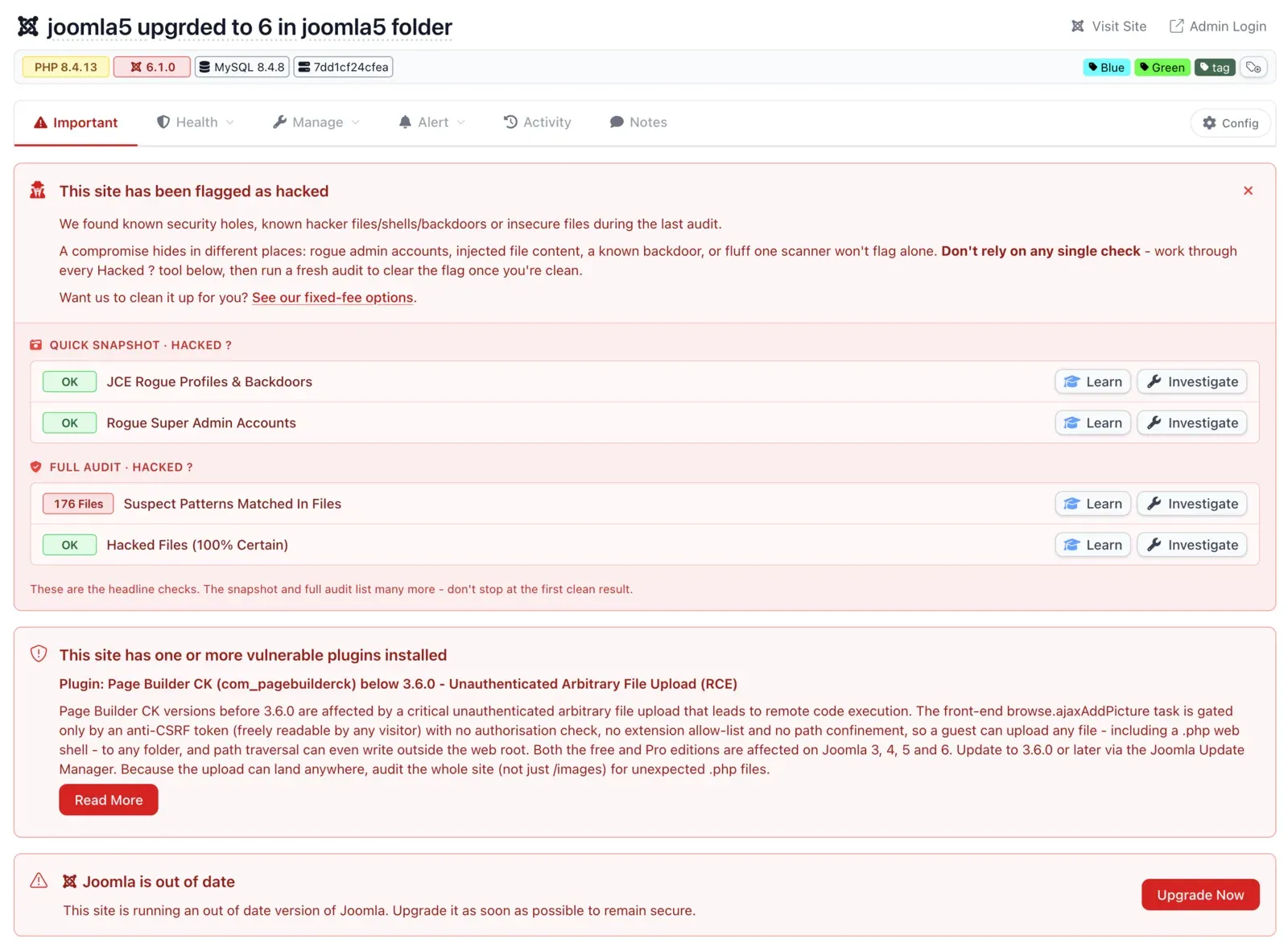
This is no longer hypothetical. The suspect content tool is what caught the first real web shell planted through this flaw, the bhup.php dropper described above. It reads every file in your webspace and flags anything that looks like a backdoor or web shell on its own merits, without us having to handcraft a pattern for this particular attack first. That is the difference between a tool that only knows the threats someone has already written a rule for and one that can catch a shell it has never seen. It does flag broadly, so it is worth knowing how to read a suspect content match versus a confirmed hacked file before you act on what it raises. Now that we are recording sites hit through this flaw, a targeted check that hunts its specific fingerprint is the next step, exactly as we did with the JCE rogue profiles and backdoors tool.
That is the whole point of connecting your sites before the next 0-day rather than after. When it drops, you are not scrambling to build a list. You already have it, you push one update, and you move on. If you are not set up yet, start a free month and the index builds itself on the first snapshot.
CVE Record
This vulnerability is now tracked as CVE-2026-56290, published on 29 June 2026 and crediting Phil Taylor of mySites.guru as the finder. It scores a CVSS 4.0 base of 10.0, the maximum, and is classified as CWE-284 (Improper Access Control), which is exactly the failure this post describes: an endpoint that checks a token but never checks permission. The official record summarises it as “an unauthenticated arbitrary file upload that allows uploading executable files and leads to full RCE”.
| Field | Detail |
|---|---|
| CVE | CVE-2026-56290 |
| Published | 29 June 2026 |
| Component | PageBuilder CK (com_pagebuilderck) |
| Vendor | Cedric Keiflin (joomlack.fr) |
| Type | Unauthenticated arbitrary file upload to remote code execution |
| CVSS 4.0 | 10.0 (critical), AV:N/AC:L/AT:N/PR:N/UI:N/VC:H/VI:H/VA:H/SC:H/SI:H/SA:H |
| CWE | CWE-284 (Improper Access Control) |
| Finder | Phil Taylor, mySites.guru |
| Affected versions | Up to and including 3.5.10 (current line); older Joomla 3 and Joomla 4 builds below the back-ported patches below |
| Fixed in | 3.6.0 for current Joomla, plus back-ported 3.1.1 (Joomla 3) and 3.4.10 (Joomla 4). All released 27 June 2026 |
This is a developing story. We published within hours of the fix, and within hours of that it was exploited in the wild, with a web shell planted on a connected site through this flaw. It is now tracked as CVE-2026-56290, scored CVSS 10.0, crediting Phil Taylor of mySites.guru as the finder. Right now: update to 3.6.0 on every site that runs PageBuilder CK, watch the Important tab, and check for the `bhup.php` web shell and any other stray PHP under `/media/com_pagebuilderck/`. The suspect content tool is already catching shells like this one.
Timeline
Cedric Keiflin ships PageBuilder CK 3.6.0
The changelog says, in full, "IMPORTANT : Fix security issue". The older lines are back-patched too, 3.1.1 for Joomla 3 and 3.4.10 for Joomla 4, so most sites have somewhere to go.
Exploitation in the wild, within hours of the fix
Our suspect content tool flags a live web shell on a connected Joomla site, planted through this exact flaw, at /media/com_pagebuilderck/gfonts/bhup.php. An upload handler that runs whatever an attacker posts to it.
CVE-2026-56290 is published at CVSS 4.0 10.0
Classified CWE-284, improper access control, which is exactly the failure: an endpoint that checks a token but never checks permission. It credits Phil Taylor of mySites.guru as the finder.
3.6.0 turns out not to have finished the job
The release added the missing permission check without correcting the upload handler behind it, so any Editor account could still upload and run a PHP file up to 3.6.2. That became CVE-2026-63048, and two further security issues followed it. The minimum safe version is now 3.6.5.
Further Reading
- PageBuilder CK RCE fixed, again, correctly this time - the 3.6.0 fix turned out to be incomplete, and what it took to actually close it.
- This was one of twelve Joomla extension vulnerabilities we disclosed in a month - the whole run in one place.
- CVE-2026-56290 - the official CVE record (CVSS 10.0, CWE-284), crediting Phil Taylor of mySites.guru as the finder.
- PageBuilder CK by Cedric Keiflin
- Joomlack forum: new PageBuilder CK release and the Joomla 3 / Joomla 4 back-ports (vendor announcement)
- Joomlack on Facebook (where the vendor posted the patched-version download links)
- Joomla Vulnerable Extensions List
- OWASP: Unrestricted File Upload
- Joomla security best practices
Frequently Asked Questions
What is the PageBuilder CK vulnerability?
Which PageBuilder CK versions are affected?
Does this need a login or any special setup to exploit?
How do I fix it?
Does unpublishing PageBuilder CK protect the site?
How do I know if one of my sites was already hacked?
 Written and edited by a human, with AI assistance. Our approach to AI