Unauthenticated Remote Code Execution in SP Page Builder found by mySites.guru
SP Page Builder is JoomShaper’s drag-and-drop page builder for Joomla, one of the most widely installed page builders in the ecosystem. We have reported issues in it before: the June 2026 unauthenticated icon-upload zero-day fixed in 6.6.2, and a round of four vulnerabilities including a pre-auth SQL injection and an open mail relay, fixed in 6.7.1. This is the one that makes those look tame. In SP Page Builder 6.7.1, the release that fixed our previous reports, mySites.guru found a pre-authentication remote code execution flaw, plus a second unauthenticated file-write issue on the same endpoint. Both were reported to JoomShaper before any public detail, and both are fixed in SP Page Builder 6.8.0, released on 12 August 2026. We re-tested the released package the same day to confirm the fixes hold.
If you run SP Page Builder on any Joomla site, update to 6.8.0 now. If you manage more than a handful of sites, read on for how to find every affected one at once.
TL;DR
- mySites.guru found a pre-authentication remote code execution flaw in SP Page Builder, and reported it privately to JoomShaper
- Unauthenticated PHP file inclusion (CVSS 4.0 9.3, Critical). The Dynamic Content “load more” endpoint renders an addon definition taken straight from the request. The addon name is concatenated into a file path with no traversal check, then included and run as PHP. It is protected only by a CSRF token, which Joomla hands to every anonymous visitor, so it is effectively pre-auth. An attacker can make the site execute a PHP file from anywhere the server can read, inside the web root or outside it
- Unauthenticated arbitrary file write (CVSS 4.0 Medium). The same endpoint lets an attacker set an addon id that becomes a filesystem path, so an anonymous request could create a directory and write a file outside the cache folder
- The flaw sits in the method directly below the one JoomShaper hardened in 6.7.1, which is why 6.7.1, our previous fix, is itself vulnerable
- Update to SP Page Builder 6.8.0 immediately
- Reported privately on 27 July 2026, fixed in 6.8.0 on 12 August 2026, 16 days later. We re-tested the released package the same day and confirmed both issues are closed
- The fix did not ship on its own. It arrived bundled with 6.8.0, a planned feature release, rather than as an immediate point release
- The Joomla CNA published CVE-2026-67285 (the file inclusion) and CVE-2026-67286 (the file write) on 12 August 2026
- The endpoint itself is still unauthenticated in 6.8.0. The two sinks we reported are fixed, but it still renders an addon definition sent by the visitor
- mySites.guru already flags every connected Joomla site still running a vulnerable version
mySites.guru discovered these issues and reported them to JoomShaper before publishing details. We are withholding the exact requests and any proof-of-concept until enough sites have updated. This is how we handle every vulnerability we find: fix first, publish second.
The worst one: an anonymous request that runs your code
SP Page Builder’s Dynamic Content feature renders lists of content, articles, tags and custom collections. When a visitor asks for more items, a front-end endpoint returns the next page of them. To do that, the endpoint takes an addon definition, supplied in the request body itself, and renders it server-side.
Rather than loading the saved addon from the page a visitor is looking at, the endpoint trusts a complete addon tree the caller hands it, and one of the things an addon has is its name. The name is used to locate the addon’s code on disk, by pasting it into a file path, and that path is then included and executed as PHP. Nothing strips or rejects ../ from the name, so the name is a free path. An addon “named” a traversal string points the include anywhere on the filesystem, and Joomla runs whatever site.php it finds there.
The only thing standing in front of the endpoint is a CSRF token check, and, as with the SQL injection we reported last week, that is not the barrier it looks like. Joomla issues a valid token to every visitor, anonymous ones included, the moment they load any page. A scripted attacker fetches a token and sends it back, so in practical terms this is pre-authentication code inclusion. The one precondition is that the collection being rendered returns at least one item, because the include happens inside the per-item loop, and the default articles collection satisfies that on any site with a single published article.
We confirmed it on our own SP Page Builder test install. We placed a harmless marker PHP file, made the unauthenticated request that pointed the include at it, and the marker’s output came back at the top of the HTTP response, proving the file ran as PHP inside the application. We then placed a second marker outside the web root entirely and it executed the same way, confirming the traversal is not confined to the site’s own folder. We did not run any harmful code.
On its own this runs PHP from a path of the attacker’s choosing. It becomes full remote code execution the moment any attacker-influenced PHP file exists somewhere the server can read: a file-write flaw in any other extension, an upload that keeps the original filename, a low-privilege account, a neighbouring account on shared hosting, or a leftover backup or staging folder. On a busy shared host that is a low bar. Treat any site that ran a vulnerable version as potentially compromised until checked.
The second one: an anonymous request that writes to your disk
Because the same endpoint renders a caller-supplied addon tree, every addon’s rendering code becomes a public endpoint driven by attacker-chosen settings. Most addons just draw HTML. Some touch the filesystem. The Flickr addon builds a cache path from the addon’s id, then creates that directory and writes a file into it. The id, like the name, comes straight from the request and is never checked.
Setting the id to a traversal string, an anonymous request creates a directory and writes a file well outside the intended cache folder. On our test install it created the directory and wrote a 31 KB file where it should not have been able to. The impact here is narrower than the code execution above: the filename is fixed, so this is not code execution by itself and it does not chain into the first issue. What it does give an unauthenticated attacker is directory creation anywhere the web user can write, the ability to overwrite that specific cache file, disk exhaustion, and forced outbound requests to a third-party API with a query string they control.
Both issues share one cause: the endpoint trusts an addon definition supplied by the visitor rather than loading it from the saved page. Fixing the traversal alone would leave that pattern in place, and every addon with a filesystem or network side effect would stay exposed. Flickr is simply the one we found with a write.
Why the last fix did not cover this
SP Page Builder 6.7.1 was the release that fixed the four issues we reported the week before, among them a pre-authentication SQL injection in the Dynamic Content controller. The 6.7.1 fix hardened that specific method: it added a permission check and an allow-list, with a code comment naming the SQL injection it was closing.
The endpoint in this report sits directly below that method, in the same file, and received neither the permission check nor any input hardening. The area was clearly on the developers’ radar when they patched the method above it. That is why a site diligently updated to 6.7.1, the fix for the previous round, is exposed to something worse. The lesson, for any maintainer, is that when you find one unauthenticated flaw in a controller it is worth auditing the whole controller, not just the reported method.
What 6.8.0 actually changed
We tested the released 6.8.0 package the day it shipped, re-running both proof-of-concept requests against a clean install. Both are closed, and the fixes are the right ones for the two sinks we reported:
- The addon name is now checked against an allow-list of plain directory names before it is used to build a path, and the include is additionally guarded by a file-existence check. Our traversal payload renders an empty item instead of executing the planted file.
- The addon id is stripped of anything outside
A-Z a-z 0-9 _ -before it reaches the filesystem, so the Flickr write can no longer escape the cache folder.
One thing did not change. The endpoint still has no authorisation check. It is still reachable by any anonymous visitor holding the CSRF token Joomla gives away, and it still renders an addon definition supplied in the request. 6.8.0 edited that same controller six times, adding an extra permission check to six other methods in the file, and left this one as it was. The two doors we reported are bolted; the corridor they open onto is unchanged.
That matters for what comes next rather than for whether you should update. You should update, today. But the pattern that produced both of these findings, trusting a component definition sent by the visitor, is still how the endpoint works, and every addon with a filesystem or network side effect is still reachable through it with attacker-chosen settings.
The release notes do not tell you any of this
Here is the entire mention of this vulnerability in the SP Page Builder 6.8.0 release notes:
SP Page Builder 6.8.0 release notes, under Updates
Hardened input validation, file handling, and access checks across the component.
That is it. One line, filed under “Updates”, sitting below “Added Copy, Paste, and Paste Style support for addons inside the Table addon” and above nothing at all. A pre-authentication remote code execution flaw, present in every release since 5.5.0, reachable by anyone on the internet with no login, is announced to users in the same register as a clipboard feature.
Judge for yourself. This is the entire 6.8.0 release note:
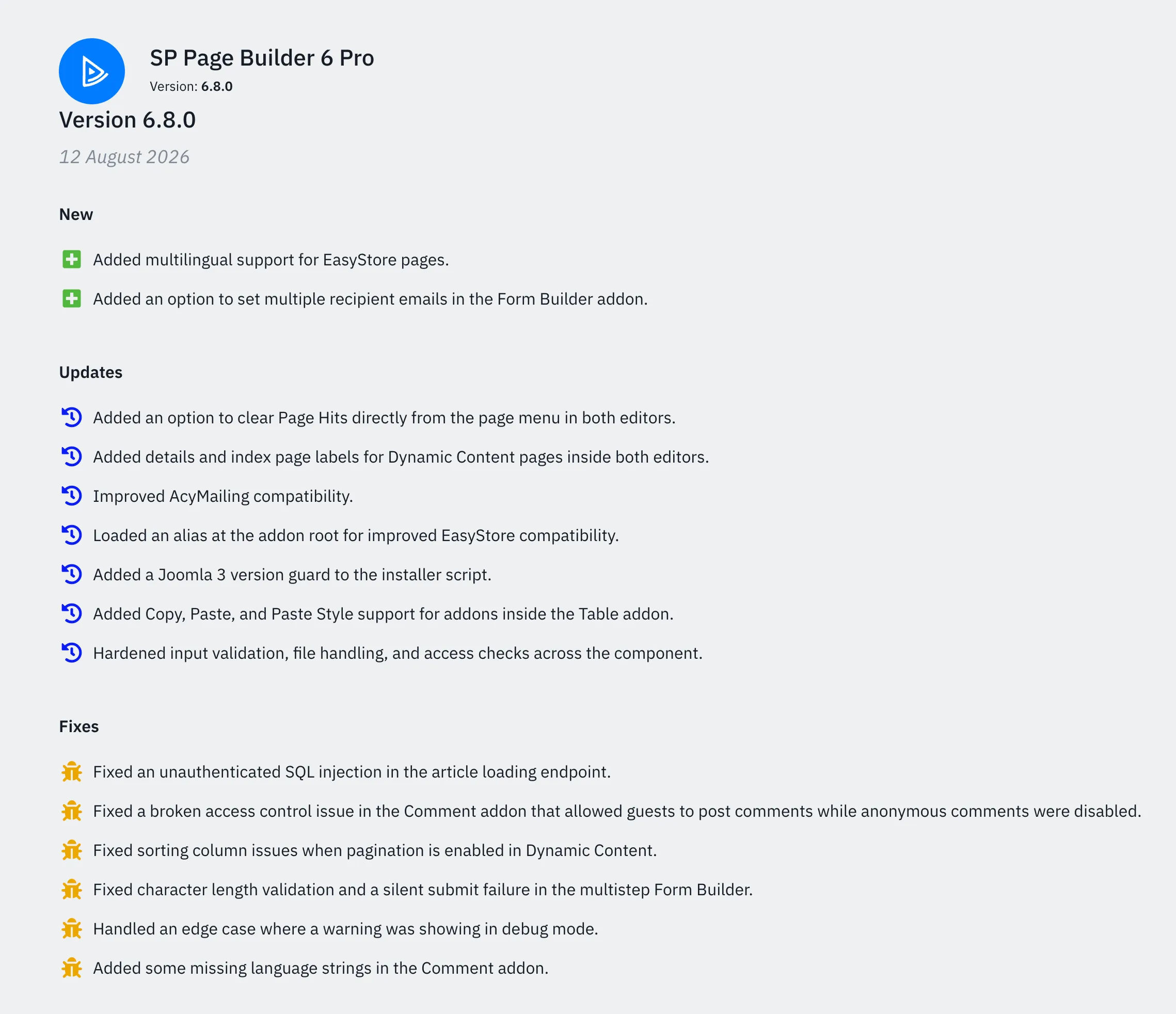
The release notes do not say “security release”. They do not say “critical”. They do not give a severity, a CVSS score, a CVE, or a hint that any of this is urgent. They do not say that a site left on 6.7.1 can be made to execute an attacker’s PHP. There is no “update immediately” anywhere on the page. A site owner reading that changelog over coffee has no way to tell this apart from a maintenance release, and will quite reasonably schedule it for whenever they next do updates.
What makes it worse is that JoomShaper clearly knows how to write a security changelog entry, because two lines further down, under “Fixes”, they do exactly that:
SP Page Builder 6.8.0 release notes, under Fixes
Fixed an unauthenticated SQL injection in the article loading endpoint.
Fixed a broken access control issue in the Comment addon that allowed guests to post comments while anonymous comments were disabled.
Both of those are named, scoped and honest. So the vagueness applied to the two issues in this article is not a house style or a limitation of their changelog format. Those two got a plain-English description; ours got “hardened input validation”. The most severe bug in the release is the most vaguely described one in the release notes, and it is not credited to anyone.
We have written before about what a security changelog entry owes the people running your code. The short version: say what class of flaw it was, say which versions were affected, say whether it needs urgent action, and name the researcher. None of that is difficult, and all of it changes whether a busy administrator patches today or next month. Vague release notes do not protect users from attackers. Attackers diff the release. Only the defenders are left guessing.
Credit where it is due, though not to the vendor. The Joomla Security Strike Team assigned CVE-2026-67285 and CVE-2026-67286 to these two issues within hours of the release, and went back and updated the credits on the earlier SP Page Builder CVEs so that mySites.guru is named there too. That is the ecosystem’s security team doing the vendor’s job for them, and doing it properly.
The fix waited for the feature release
JoomShaper acknowledged both issues on the day we reported them, 27 July, and confirmed a fix was in progress. That fix reached site owners sixteen days later, on 12 August, as part of SP Page Builder 6.8.0. There was no 6.7.2 in between.
Look at what else 6.8.0 has: multilingual page support for EasyStore, multiple recipient emails in the Form Builder, clearing page hits from the editor menu, labels on Dynamic Content pages, improved AcyMailing compatibility, copy and paste inside the Table addon. That is a planned feature drop, months in the making, and the vendor’s own announcement opens by calling it “packed with exciting new features and improvements”. The patch for a pre-authentication remote code execution flaw travelled along with it.
An allow-list on a directory name and a sanitiser on an id did not need to wait for multilingual EasyStore pages. They could have gone out as 6.7.2 the same week, on their own, with a release note saying what they were for. Instead every SP Page Builder site on the internet stayed exposed for sixteen days to a flaw the vendor already knew about, so that the fix could arrive on the feature release’s schedule.
Sixteen days is not a scandal in isolation. Plenty of vendors take considerably longer, and JoomShaper answered within hours and fixed both sinks properly when they did. The problem is the coupling. Once a security fix is bundled with a feature release, the date it reaches users is decided by whatever else is in the box, by QA on multilingual storefronts and clipboard support in table addons, and that is exactly backwards for the one class of change that should never wait for anything.
The 6.8.0 announcement is worth reading for what it does cover. It gives the unauthenticated SQL injection in the article loading endpoint a dedicated “Security Enhancement” section: affected versions, the fixed version, a CVE, the CWEs, step-by-step upgrade instructions, and a credit to the researchers who reported it, ourselves included. That is a good vendor security note, and it shows the standard JoomShaper is perfectly capable of meeting. The file inclusion and the file write described in this article appear nowhere on that page.
Which versions are affected?
The vulnerable code is present in SP Page Builder 6.7.1, the current release when we reported this, and from our testing in every version back to 5.5.0, where the Dynamic Content feature was introduced. The relevant files are byte-for-byte identical across 6.6.2, 6.7.0 and 6.7.1, so this is not a 6.7.1 regression, it is long-standing. JoomShaper fixed it in SP Page Builder 6.8.0.
If you run any version of SP Page Builder earlier than 6.8.0, assume your site is affected and update now. The code execution needs no login, so if the site is online, the endpoint is reachable. 6.8.0 is no longer the version to be on either: we found five more issues in 6.9.0, including an Author-level SQL injection that reads the whole database, all fixed in 6.9.1. Install 6.9.1 or later.
How do you update SP Page Builder safely?
- Take a backup first. Before any extension update on a production Joomla site, back up the database and files. If you use mySites.guru, trigger a snapshot or a full backup first.
- Update through Joomla’s Extensions manager, or in bulk from mySites.guru. On a single site, open the Joomla administrator, go to System, then Update, then Extensions, and let Joomla pull SP Page Builder 6.8.0. If you manage more than one site, use the mySites.guru mass update feature to upgrade SP Page Builder across every affected site from one dashboard.
- Confirm the version. After updating, check SP Page Builder reports 6.8.0 or later.
- Clear caches. Clear Joomla’s cache and any CDN or page cache.
Because this is a code-execution flaw, updating closes the door but does not undo anything an attacker may already have done while it was open. If a vulnerable version was live and internet-facing for any length of time, treat the site as potentially compromised: check for unexpected files and admin users, rotate the Joomla secret and any stored credentials, and restore from a known-good backup if anything looks wrong.
How do I find every SP Page Builder site I manage?
Up to about ten sites, you can log in to each Joomla admin and check. Past that, you need a single view. mySites.guru keeps a live inventory of every extension, template and framework on every Joomla and WordPress site in your account. You search for SP Page Builder once and get back every connected site running it, the version each one is on, and whether an update is available.
View every SP Page Builder install across your sites
Search for SP Page Builder across every connected Joomla site and filter for anything earlier than 6.8.0. Not a subscriber? Sign up free and connect your sites.
Why page builders keep producing this
Page builders make attractive targets for the same reason they are useful: they render content through front-end endpoints that anonymous visitors are meant to reach. An element that loads more items, a contact form that accepts a submission, none of it can require a login, because the whole point is that visitors use it. Every one of those public endpoints is attack surface, and when the code behind them trusts request input, an anonymous visitor becomes an anonymous attacker. This flaw is the sharp end of that: the endpoint trusted an entire component definition from the request, and one field in it decided which PHP file to run.
The same shape has shown up across the ecosystem this year, from PageBuilder CK to Quix and the wider month of Joomla disclosures. Page builders are worth using. The ones that accept input from anonymous visitors simply need updating the moment a fix exists, which makes these updates security-critical rather than feature maintenance.
Stay ahead of the next one
There will be another, because Joomla runs on thousands of third-party extensions and the ones that accept input from anonymous visitors keep producing bugs like these. The hard part is never the update itself. It is knowing a fix exists, knowing which of your sites are affected, and getting to them before an attacker does.
That is the job mySites.guru does for you. It keeps a live inventory of every extension on every Joomla and WordPress site in your account, flags the ones with a known vulnerability, and lets you push the update to all of them from one screen.
Get free email alerts when a Joomla vulnerability breaks
We email a plain-English alert the moment a serious flaw like this one is disclosed, with the affected versions and what to do. No charge, unsubscribe any time.
Want the alerts and the tooling to act on them? Start with a free audit on one site and see your full extension inventory, or sign up for mySites.guru to get vulnerability alerts and one-click updates across every site you manage.
Disclosure and severity
The headline finding is an unauthenticated PHP local file inclusion (CWE-98, path traversal per CWE-22) reachable over the network, needing only a CSRF token that Joomla issues to everyone. It yields execution of PHP from an attacker-chosen path and, given any writable-and-readable site.php, full remote code execution. The second finding is an unauthenticated arbitrary directory creation and file write (CWE-22), bounded by a fixed filename.
We score every issue under CVSS 4.0. The file inclusion comes out at 9.3, Critical: no privileges, no user interaction, network reachable, with a full compromise of confidentiality, integrity and availability once code runs.
CriticalmySites.guru assessment · CVE-2026-67285
Unauthenticated PHP file inclusion, pre-auth code execution. Reachable over the internet with only the CSRF token Joomla hands to every visitor. Runs PHP from an attacker-chosen path, inside or outside the web root, and becomes full remote code execution given any writable PHP file.
CVSS:4.0/AV:N/AC:L/AT:N/PR:N/UI:N/VC:H/VI:H/VA:H/SC:N/SI:N/SA:NWhat does this mean?
CVSS 4.0 scores how severe a flaw is, from 0 (no impact) to 10 (critical). Each pair of letters in the string above is one metric; here is what this one's says.
How it is reached
- AV:N
- Network: Reachable across the internet
- AC:L
- Low: Nothing to work around, it just works
- AT:N
- None: Works against any affected install
- PR:N
- None: No account needed
- UI:N
- None: Nobody has to be tricked into anything
What it does to the site
- VC:H
- High: Everything the site holds can be read
- VI:H
- High: Data and files can be altered at will
- VA:H
- High: The site can be taken down
What it does beyond the site
- SC:N
- None: Other systems keep their data
- SI:N
- None: Other systems keep their integrity
- SA:N
- None: Other systems stay up
MediummySites.guru assessment · CVE-2026-67286
Unauthenticated arbitrary directory create and file write, bounded by a fixed filename.
CVSS:4.0/AV:N/AC:L/AT:N/PR:N/UI:N/VC:N/VI:L/VA:L/SC:N/SI:N/SA:NWhat does this mean?
CVSS 4.0 scores how severe a flaw is, from 0 (no impact) to 10 (critical). Each pair of letters in the string above is one metric; here is what this one's says.
How it is reached
- AV:N
- Network: Reachable across the internet
- AC:L
- Low: Nothing to work around, it just works
- AT:N
- None: Works against any affected install
- PR:N
- None: No account needed
- UI:N
- None: Nobody has to be tricked into anything
What it does to the site
- VC:N
- None: Nothing can be read
- VI:L
- Low: Some data can be altered
- VA:L
- Low: The site slows or stutters
What it does beyond the site
- SC:N
- None: Other systems keep their data
- SI:N
- None: Other systems keep their integrity
- SA:N
- None: Other systems stay up
| Field | Detail |
|---|---|
| Component | SP Page Builder for Joomla (com_sppagebuilder) |
| Vendor | JoomShaper (joomshaper.com) |
| Type | Unauthenticated PHP local file inclusion via path traversal, pre-auth RCE (CWE-98 / CWE-22); unauthenticated arbitrary directory creation and file write (CWE-22) |
| CVSS 4.0 | 9.3 (Critical) file inclusion; 6.9 (Medium) file write |
| CVE | CVE-2026-67285 (the file inclusion) and CVE-2026-67286 (the file write), published by the Joomla CNA on 12 August 2026 |
| Impact | Unauthenticated execution of PHP from an arbitrary filesystem path, full remote code execution given any writable PHP file; unauthenticated directory creation and file write outside the cache folder |
| Finder | Phil Taylor, mySites.guru |
| Affected versions | 6.7.1 and earlier; vulnerable code present from 5.5.0 |
| Fixed in | SP Page Builder 6.8.0 |
| Reported | 27 July 2026 (privately to JoomShaper, Joomla security team CC’d) |
| Acknowledged | 27 July 2026 (JoomShaper confirmed both issues, fix in progress) |
| Pre-release build supplied for testing | 12 August 2026 |
| Fixed | 12 August 2026, in SP Page Builder 6.8.0 |
| Fix verified by mySites.guru | 12 August 2026, against the released 6.8.0 package |
| Time to fix | 16 days |
Timeline
Reported privately, and acknowledged the same day
An unauthenticated PHP file inclusion in the Dynamic Content load-more endpoint, where the addon name is concatenated into a file path with no traversal check and then included and run as PHP, plus an unauthenticated arbitrary directory creation and file write. JoomShaper confirms a fix is in progress.
SP Page Builder 6.8.0 ships, sixteen days later
There was no 6.7.2 in between. We read the released package and verified both issues are fixed the same day. The changelog lists the fixes among routine entries with no visual distinction.
CVE-2026-67285 and CVE-2026-67286 are published by the Joomla CNA
The file inclusion at CVSS 4.0 9.3 Critical and the file write at 6.9 Medium, both crediting Phil Taylor of mySites.guru.
Further Reading
- The September 2026 round: SQL injection and a captcha bypass - five more issues, fixed in 6.9.1, and the version you actually want to be on.
- SP Page Builder's Joomla 3 patch reaches 1.0.3 - the Joomla 3 back-port of that September round, corrected after we found two more gaps in it.
- Our SP Page Builder SQL injection and mail relay disclosure - the four issues fixed in 6.7.1, the release this flaw stayed in.
- The June 2026 SP Page Builder icon-upload zero-day - an earlier, separate flaw in the same component, exploited in the wild and fixed in 6.6.2.
- Why AJAX endpoints are a CMS security blind spot - the recurring public-endpoint pattern behind flaws like these.
- CWE-98: PHP Remote File Inclusion and CWE-22: Path Traversal - the official references for these weakness classes.
- JoomShaper's SP Page Builder 6.8.0 announcement - the vendor's own write-up of the release, including the security note for the separate SQL injection it also fixes.
- JoomShaper - the vendor's site, where SP Page Builder 6.9.1 is available.
Frequently Asked Questions
What is the SP Page Builder remote code execution flaw?
Is this the same as the SQL injection you reported in 6.7.1?
Which SP Page Builder versions are affected?
How do I know if my sites are affected?
What can an attacker actually do with this?
 Written and edited by a human, with AI assistance. Our approach to AI