Exposed Customer Invoices, Order Forgery and SQL Injection in EasyStore for Joomla found by mySites.guru
EasyStore is JoomShaper’s ecommerce component for Joomla, the shopping-cart engine behind a growing number of Joomla shops. Here is the finding that will make any shop owner wince: before EasyStore 2.0.2, any logged-in customer could pull up every other customer’s order and printable invoice, with full name, email address, billing and shipping addresses, phone number and complete purchase history, by changing one number in the URL. On a shop with open customer registration, which is most shops, “any logged-in customer” means anyone who signs up. mySites.guru found that during routine security research, along with two more issues that need no login at all, and reported all three to JoomShaper before disclosing anything publicly.
If you run EasyStore on any Joomla site, update to 2.0.2 now. If you manage more than a handful of shops, read on for how to find every affected one at once, and for how JoomShaper chose to ship the fix.
TL;DR
- mySites.guru found three critical vulnerabilities in EasyStore 2.0.1 and reported them to JoomShaper
- Cross-customer invoice and order exposure. The order and invoice views only checked that someone was logged in, never that the order belonged to them, so any customer could read every other customer’s order and invoice by changing the id in the URL. Names, emails, addresses, phone numbers, the lot
- Unauthenticated order forgery. An anonymous request to the order-repayment endpoint could mark any order paid with no login, no token, and no contact with any payment gateway. Goods released without payment, and the same flaw rewrites any order’s fields by changing an id
- Unauthenticated SQL injection. The product-list sort parameter placed request input straight into the database query’s
ORDER BY, so an anonymous visitor could read the entire database: Joomla accounts, password hashes, the site secret, and every customer record - Update to EasyStore 2.0.2 immediately. Affected: 2.0.1 and every earlier version
- Reported privately on 21 July 2026, fixed the next day in 2.0.2, but shipped with no security advisory and no credit. The Joomla CNA has assigned three CVEs, CVE-2026-65759, CVE-2026-65760 and CVE-2026-65761, and rated two of them Critical
- mySites.guru already flags every connected Joomla site still running a vulnerable version, so you do not have to check each shop by hand
mySites.guru discovered these issues and reported them to JoomShaper before publishing details. We withheld the exact requests and any proof-of-concept until a fix was available and site owners had a reasonable window to update. This is how we handle every vulnerability we find: fix first, publish second.
How JoomShaper shipped the fix: with no announcement
We reported all three privately on 21 July 2026. JoomShaper replied on 22 July, confirmed they had reproduced and verified every one, said they were “treating these issues with the highest priority”, thanked us, and said they looked forward to continuing to work with us. The next day, 23 July, they shipped EasyStore 2.0.2, and it closes all three.
To be fair to the code, we checked. We downloaded 2.0.2 and read the exact paths we had reported: the repayment endpoint now requires a token, checks that the order belongs to the caller, and takes the payment status from the stored order rather than from the request; the product sort is restricted to a fixed ASC/DESC allow-list; and the order and invoice views now verify that the order belongs to the person viewing it. The fix is correct and complete, and we have no complaint about the code.
The handling is another matter. The 2.0.2 release has no security advisory, the changelog never says “security release”, and the three fixes sit among routine feature additions and cosmetic bug fixes, each written in language a shop owner would read straight past. Here is the changelog as JoomShaper published it:
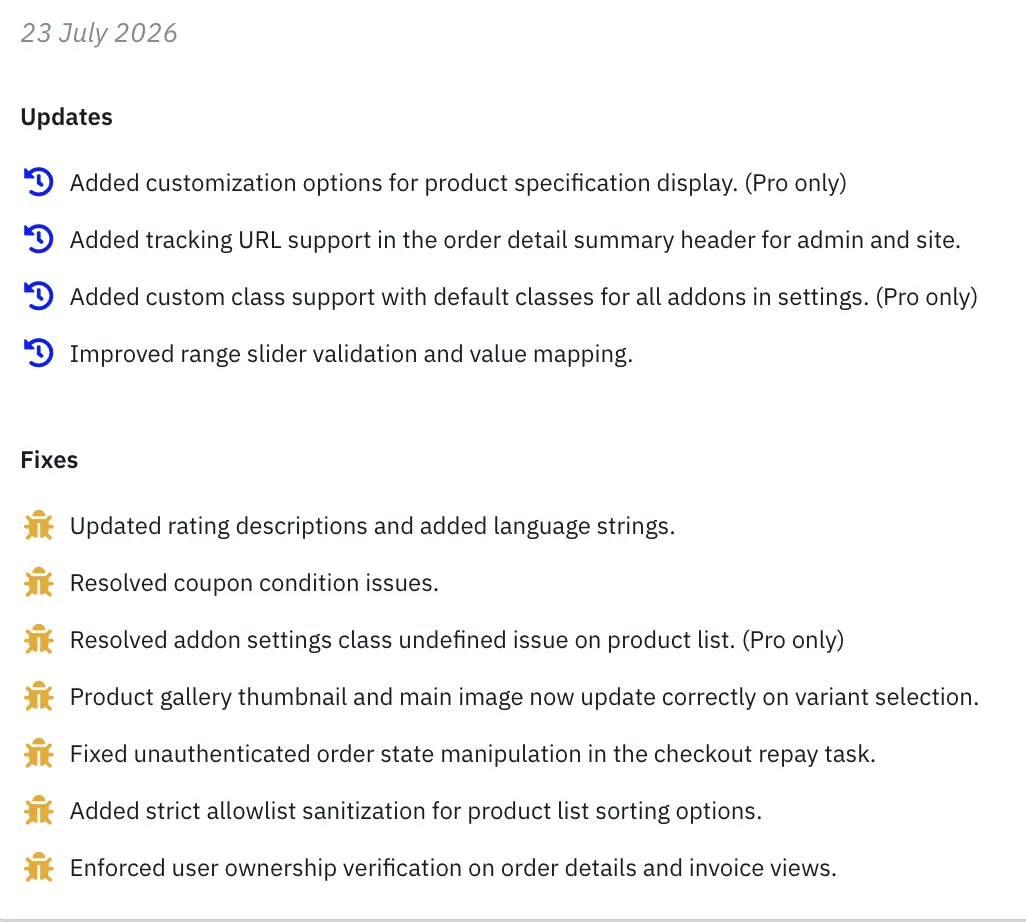
The three critical security fixes are the last three lines of the Fixes list, sitting directly under a coupon bug and a product gallery thumbnail glitch, with nothing to mark them out as different. Here is what we reported, set against the exact words JoomShaper used to describe each fix:
| Our finding | How JoomShaper described it in the 2.0.2 changelog | Severity (CVSS 4.0) |
|---|---|---|
| Any logged-in customer could read every other customer’s order and invoice by changing the id in the URL | “Enforced user ownership verification on order details and invoice views” | 9.2, Critical |
| An anonymous request could mark any order paid, and rewrite any order’s fields, with no login | “Fixed unauthenticated order state manipulation in the checkout repay task” | 8.7, High |
| An anonymous visitor could read the entire database through the product sort parameter | “Added strict allowlist sanitization for product list sorting options” | 9.3, Critical |
Only one of those three lines even contains the word “unauthenticated”. There was no coordinated disclosure date, no heads-up that the release was going out, no CVE requested, and no credit to the finder. A shop owner scanning that changelog has no way to know that 2.0.2 is the most urgent update EasyStore has shipped this year, or that staying on 2.0.1 leaves every customer’s invoice one URL edit away from any logged-in visitor.
Because JoomShaper did not request one, mySites.guru took these issues to the Joomla CNA, which assigned three CVEs on 23 July 2026: CVE-2026-65759 for the order forgery, CVE-2026-65760 for the cross-customer invoice disclosure and CVE-2026-65761 for the SQL injection. The CVE records name Phil Taylor as the finder, the credit JoomShaper’s own release withheld. The CNA rated the SQL injection 9.3 Critical and the invoice disclosure 9.2 Critical, higher than our own conservative scores. There is now a public, citable record that does not depend on a changelog line reading like a slider tweak.
Neither of those steps should have fallen to us. The Joomla Security Strike Team has since proposed a Manual page for extension developers, and points 11 and 12 of those twenty rules cover exactly this: request the CVE from the Joomla CNA before you disclose, and always offer the reporter credit in the wording they choose.
Treat EasyStore 2.0.2 as an urgent security release, whatever its changelog implies. Two of the three flaws need no login, and the third exposes your entire customer base’s personal data to anyone who can register. If a vulnerable version was live on a shop that handles real customers, this is a personal-data breach you may be obliged to report.
The three flaws in detail
EasyStore is a full ecommerce component: products, a cart, checkout, orders, invoices, coupons and payment plugins. That is a large front-end attack surface, because a shop has to accept requests from anonymous visitors to function. Most of it is built carefully. Three places were not.
1. Every customer’s invoice, one URL edit away
The flaw that leads this post is a broken access control, the kind that exposes personal data. EasyStore’s order detail page and its printable invoice only checked that someone was logged in. They never checked that the order being viewed actually belonged to the person viewing it. The query that loads the order (OrderManager.php:917-938) filtered on the order id alone, with no customer-ownership condition.
Because order ids are sequential integers, any logged-in customer could walk through them one by one and read every other customer’s order and printable invoice: full name, email address, billing and shipping addresses, phone number, and complete purchase history. Change id=1041 to id=1042 and you are looking at the next customer’s invoice. On a shop with open customer registration, “any logged-in customer” means anyone. That is a serious personal-data exposure and, under the UK GDPR and equivalents, a reportable breach if it happened on a live shop.
The tell here is that EasyStore already gets this right elsewhere. Guest orders are protected by an unguessable token emailed to the customer, and the order-cancel path does check ownership. The detail and invoice views simply missed the same check. The fix (which we confirmed in 2.0.2) adds the ownership condition so a customer can only ever load their own orders.
Data exposure like this leaves no trace. No file changes, no new admin user, nothing for an integrity scanner to catch. If a vulnerable version was ever live on a shop with real customers, you have to assume the customer list and its invoices were reachable, and handle it as a potential data breach.
2. Marking any order paid, for free, with no login
The most direct of the three, and it needs no account. EasyStore has an order-repayment path, meant to let a customer retry payment on an order. The endpoint took the order details straight from the request body as JSON, including the payment status, and for any enabled manual payment method (Cash on Delivery is enabled by default and qualifies) it wrote that status to the database.
The root cause was in the checkout controller, which built the order object from client JSON and called updateOrder(), ending in a blind write at OrderController.php:299 ($orm->update('#__easystore_orders', $data, 'id')). Nothing in that path checked a login, a CSRF token, ownership of the order, or, crucially, whether any payment actually happened. There was no call to a payment gateway anywhere in it.
So an anonymous attacker could send one crafted request and flip any order to paid. On a shop that ships on payment status, that is goods dispatched for free. Because the order id is attacker-chosen and sequential, the same flaw also let an attacker rewrite arbitrary fields on any order in the shop, addresses, customer id and discount included.
We proved it on our own EasyStore test install: a single anonymous request turned a test order from unpaid to paid, and we then restored the test data. The fix (confirmed in 2.0.2) ties the repayment path to the real customer, requires a token, and only ever sets payment status from the stored order or a verified gateway response.
3. Unauthenticated SQL injection through the product sort
The product listing lets shoppers sort results, and the sort option arrives in a request parameter, filter_sortby. EasyStore split that value into a column and a direction, and the direction was passed through to the database query’s ORDER BY clause without being checked against a list of allowed values.
The direction helper (FilterHelper.php:741) returned the request’s direction unchanged, and the model (ProductsModel.php:923) concatenated it straight into the query. A sort direction is one of the few places you cannot simply quote a value safely, which is exactly why the surrounding code has to restrict it to ASC or DESC. This path did not, while the sibling brand and collection listings did. That gap was the bug.
The consequence is a textbook SQL injection reachable by an anonymous visitor: an attacker could read any table in the Joomla database, from user accounts and password hashes to the site secret and every customer’s stored order data. We confirmed it on our test install with a time-based proof, a crafted sort value that made the database pause for a measurable few seconds versus an instant baseline, which shows the injected code ran. We did not extract real data. The fix (confirmed in 2.0.2) restricts the direction to a fixed allow-list before it reaches the query.
A database read writes nothing. No file changes, no new admin user, no web shell, nothing for an integrity scanner to find. If a vulnerable version was ever live on a busy shop, treat the database as potentially copied: rotate the Joomla secret and any stored API keys, and assume password hashes are known.
Fair credit: the PayPal side was built correctly
It would be easy to read three findings and conclude the whole component is careless. It is not. The part that most often goes wrong in ecommerce extensions, the payment gateway callback, is built properly here. EasyStore’s PayPal webhook verifies the notification’s cryptographic signature, checks the merchant email, and reads the payment status back from PayPal’s own signed response rather than trusting request parameters. The order total is computed server-side from the database, not taken from the client. That is the right way to do it, and it is worth saying so.
The order-forgery flaw was not a weakness in PayPal handling. It was a separate, manual-payment code path that skipped the checks the gateway path applied. The lesson is a familiar one: security has to hold on every path that changes state, not just the obvious one.
Which versions are affected?
EasyStore 2.0.1, the current release at the time of disclosure, and every earlier version are affected by all three issues. JoomShaper fixed them in EasyStore 2.0.2, released 23 July 2026.
If you run any version of EasyStore earlier than 2.0.2, assume your shop is affected and update now. Two of the three flaws need no login, so there is no second precondition for an attacker to satisfy: if the shop is online, the endpoints are reachable.
How do you update EasyStore safely?
- Take a backup first. Before any extension update on a production Joomla site, back up the database and files. If you use mySites.guru, trigger a snapshot or a full backup first.
- Update through Joomla’s Extensions manager, or in bulk from mySites.guru. On a single site, open the Joomla administrator, go to System, then Update, then Extensions, and let Joomla pull EasyStore 2.0.2. If you manage more than one shop, use the mySites.guru mass update feature to upgrade EasyStore across every affected site from one dashboard.
- Confirm the version. After updating, check EasyStore reports 2.0.2 or later.
- Clear caches. Clear Joomla’s cache and any CDN or page cache.
Updating closes the door. It does not undo any data an attacker may already have read, so if you handle customer data and were on a vulnerable version for a while, treat credentials and exposed data as potentially known, and review recent orders for any that were marked paid without a matching payment.
How do I find every EasyStore shop I manage?
The first question after any extension security release is the awkward one: which of my sites actually run this? Up to about ten sites, you can log in to each Joomla admin and check. Past that, you need a single view.
mySites.guru keeps a live inventory of every extension, template and framework on every Joomla and WordPress site in your account. You search for EasyStore once and get back every connected site running it, the version each one is on, and whether an update is available.
View every EasyStore install across your sites
Search for EasyStore across every connected Joomla site and filter for anything earlier than 2.0.2. Not a subscriber? Sign up free and connect your sites.
Why ecommerce extensions have extra weight
A shop is not a brochure. When a page builder has a bug, the exposure is the site’s data. When an ecommerce component has one, the exposure is the site’s data plus its customers’ personal and order details, plus, in the order-forgery case, real money. That raises the stakes on exactly the code that has to accept anonymous requests to work: the cart, the checkout, the payment callbacks.
We have found the same shape of issue across the Joomla extension ecosystem this year, in page builders, form builders, calendars and newsletter systems: a public endpoint that reaches a sensitive operation with too little checking in between. The lesson is not “avoid these tools”. The reputable ones are usually well maintained, and the EasyStore fix itself is solid. What let this one down was not the code but the handling: a set of critical flaws patched with no security notice, which leaves the shop owners who most need to update fastest with the least reason to think they must. Keeping these extensions updated is security-critical, not just feature maintenance, and that is far easier when something is watching the versions for you.
Stay ahead of the next one
There will be another, because Joomla runs on thousands of third-party extensions and the ones that accept input from anonymous visitors keep producing bugs like these. The hard part is never the update itself. It is knowing a fix exists, knowing which of your sites are affected, and getting to them before an attacker does, which is harder still when a critical fix ships without a word about security.
That is the job mySites.guru does for you. It keeps a live inventory of every extension on every Joomla and WordPress site in your account, flags the ones with a known vulnerability, and lets you push the update to all of them from one screen.
Get free email alerts when a Joomla vulnerability breaks
We email a plain-English alert the moment a serious flaw like this one is disclosed, with the affected versions and what to do. No charge, unsubscribe any time.
Want the alerts and the tooling to act on them? Start with a free audit on one site and see your full extension inventory, or sign up for mySites.guru to get vulnerability alerts and one-click updates across every site you manage.
Disclosure and severity
Two of these three flaws are reachable by an anonymous visitor over the network with no privileges: the order forgery (a broken access control that changes order state and payment status, CWE-862 and CWE-639) and the SQL injection (CWE-89). The third, cross-customer order and invoice disclosure, is an insecure direct object reference (CWE-639) reachable by any authenticated customer.
The Joomla CNA scored these three issues when it assigned the CVEs, and rated two of the three Critical: the SQL injection (CVE-2026-65761) at 9.3 and the cross-customer invoice disclosure (CVE-2026-65760) at 9.2, with the order forgery (CVE-2026-65759) at 8.7, High. Our own pre-assignment scores were more conservative, and it is worth being open about why. We scored the SQL injection 8.7 on confidentiality alone, treating it as a read through the sort clause; the CNA scored it across confidentiality, integrity and availability, which takes it to 9.3. We scored the invoice disclosure 7.1 because in practice it needs a logged-in customer account; the CNA scored it with no privilege requirement and a system-level confidentiality impact, which takes it to 9.2. The direction is the same either way, and we treat all three with the urgency the Critical ratings imply.
Each finding, scored under CVSS 4.0 by the Joomla CNA, worst first:
CriticalJoomla CNA · CVE-2026-65761
Unauthenticated SQL injection. Reachable over the internet with no login, and reads the entire site database, password hashes included.
CVSS:4.0/AV:N/AC:L/AT:N/PR:N/UI:N/VC:H/VI:H/VA:H/SC:N/SI:N/SA:NWhat does this mean?
CVSS 4.0 scores how severe a flaw is, from 0 (no impact) to 10 (critical). Each pair of letters in the string above is one metric; here is what this one's says.
How it is reached
- AV:N
- Network: Reachable across the internet
- AC:L
- Low: Nothing to work around, it just works
- AT:N
- None: Works against any affected install
- PR:N
- None: No account needed
- UI:N
- None: Nobody has to be tricked into anything
What it does to the site
- VC:H
- High: Everything the site holds can be read
- VI:H
- High: Data and files can be altered at will
- VA:H
- High: The site can be taken down
What it does beyond the site
- SC:N
- None: Other systems keep their data
- SI:N
- None: Other systems keep their integrity
- SA:N
- None: Other systems stay up
CriticalJoomla CNA · CVE-2026-65760
Cross-customer order and invoice IDOR. Any logged-in customer can read every other customer's invoice, full name, email, billing and shipping addresses, phone number and purchase history included.
CVSS:4.0/AV:N/AC:L/AT:N/PR:N/UI:N/VC:H/VI:N/VA:N/SC:H/SI:N/SA:NWhat does this mean?
CVSS 4.0 scores how severe a flaw is, from 0 (no impact) to 10 (critical). Each pair of letters in the string above is one metric; here is what this one's says.
How it is reached
- AV:N
- Network: Reachable across the internet
- AC:L
- Low: Nothing to work around, it just works
- AT:N
- None: Works against any affected install
- PR:N
- None: No account needed
- UI:N
- None: Nobody has to be tricked into anything
What it does to the site
- VC:H
- High: Everything the site holds can be read
- VI:N
- None: Nothing can be altered
- VA:N
- None: The site stays up
What it does beyond the site
- SC:H
- High: Data on other systems can be read
- SI:N
- None: Other systems keep their integrity
- SA:N
- None: Other systems stay up
HighJoomla CNA · CVE-2026-65759
Unauthenticated order and payment forgery. Marks any order paid and rewrites arbitrary order records, with no login needed.
CVSS:4.0/AV:N/AC:L/AT:N/PR:N/UI:N/VC:N/VI:H/VA:N/SC:N/SI:N/SA:NWhat does this mean?
CVSS 4.0 scores how severe a flaw is, from 0 (no impact) to 10 (critical). Each pair of letters in the string above is one metric; here is what this one's says.
How it is reached
- AV:N
- Network: Reachable across the internet
- AC:L
- Low: Nothing to work around, it just works
- AT:N
- None: Works against any affected install
- PR:N
- None: No account needed
- UI:N
- None: Nobody has to be tricked into anything
What it does to the site
- VC:N
- None: Nothing can be read
- VI:H
- High: Data and files can be altered at will
- VA:N
- None: The site stays up
What it does beyond the site
- SC:N
- None: Other systems keep their data
- SI:N
- None: Other systems keep their integrity
- SA:N
- None: Other systems stay up
The vectors above are the Joomla CNA’s. Our own pre-assignment reads were more conservative on two of them: we scored the SQL injection on confidentiality alone, as a read through the sort clause, and the customer-invoice IDOR at 7.1 because in practice it needs a logged-in account. The CNA scored the SQL injection across full confidentiality, integrity and availability, and the IDOR with no privilege requirement and a system-level confidentiality impact, which is what takes both into the Critical range. We reported all three to JoomShaper as Critical, and the invoice disclosure, whose practical impact is the whole customer base’s personal data, is why it leads this post.
| Field | Detail |
|---|---|
| Component | EasyStore for Joomla (com_easystore) |
| Vendor | JoomShaper (joomshaper.com) |
| Type | Cross-customer IDOR data exposure (CWE-639); unauthenticated order forgery / broken access control (CWE-862, CWE-639); unauthenticated SQL injection (CWE-89) |
| CVSS 4.0 | 9.3 (Critical) SQL injection; 9.2 (Critical) cross-customer invoice IDOR; 8.7 (High) order/payment forgery (Joomla CNA scores) |
| CVE | CVE-2026-65759 (order/payment forgery), CVE-2026-65760 (cross-customer IDOR), CVE-2026-65761 (SQL injection), assigned by the Joomla CNA on 23 July 2026; the CVE records name Phil Taylor as the finder. JoomShaper did not request a CVE and gave no disclosure credit |
| Impact | Cross-customer personal-data and invoice disclosure; free orders and arbitrary order tampering; anonymous read of the whole database including password hashes |
| Finder | Phil Taylor, mySites.guru |
| Affected versions | 2.0.1 and all earlier versions |
| Fixed in | EasyStore 2.0.2 |
| Reported | 21 July 2026 (privately to JoomShaper) |
| Acknowledged | 22 July 2026 (JoomShaper reproduced and verified all three) |
| Fixed | 23 July 2026, EasyStore 2.0.2 (shipped with no security advisory) |
Timeline
Three critical issues reported privately to JoomShaper
Cross-customer invoice and order exposure, unauthenticated order forgery, and an unauthenticated SQL injection, all in EasyStore 2.0.1 and every earlier version. All public detail withheld.
JoomShaper confirms it has reproduced and verified all three
The vendor says it is treating the issues with the highest priority and thanks us.
EasyStore 2.0.2 ships and closes all three
The changelog lists the fixes among routine entries with no visual distinction, no security wording, and no credit to the reporter.
The Joomla CNA assigns three CVEs
CVE-2026-65759 for the order forgery, CVE-2026-65760 for the cross-customer invoice disclosure and CVE-2026-65761 for the SQL injection, all naming Phil Taylor as the finder. We went to the CNA because JoomShaper did not. The CNA rated the SQL injection 9.3 Critical and the invoice disclosure 9.2 Critical, higher than our own conservative scores.
Further Reading
- Our Quix Page Builder SQL injection disclosure and the wider month of Joomla security disclosures - the same class of bug across the ecosystem.
- Why AJAX endpoints are a CMS security blind spot - the recurring public-endpoint pattern behind flaws like these.
- How to check your Joomla database security - what to review and rotate if a vulnerable extension was ever live.
- CWE-639: Insecure Direct Object Reference and CWE-89: SQL Injection - the official references for these weakness classes.
- JoomShaper - the vendor's site, where EasyStore 2.0.2 is available.
- Cotton Cloud patched the login, then the data - the same by-id ownership gap in a Joomla file storage extension, and the fix that looked right in the diff and never ran.
Frequently Asked Questions
What was the worst EasyStore vulnerability?
Do I need to log in to exploit these?
Which EasyStore versions are affected?
Did JoomShaper release this as a security update?
How do I know if my shops are affected?
Could someone have read customer data or got free orders before the fix?
 Written and edited by a human, with AI assistance. Our approach to AI