Emails from mailer-test@mysites.guru

Several people have noticed emails to mailer-test@mysites.guru in their mail client’s sent items. Your site sends one at the start of every mySites.guru audit, and the same email used to go to AuditMailerTest@myjoomla.io.
It used to be AuditMailerTest@myjoomla.io
The test now goes to mailer-test@mysites.guru. A site on an older connector may still send to the old address until its connector auto-upgrades, usually within 24 hours, so you may find either address in a Sent folder. The old address will be retired.
Here is an earlier test email to the old address in a mail client’s sent folder:
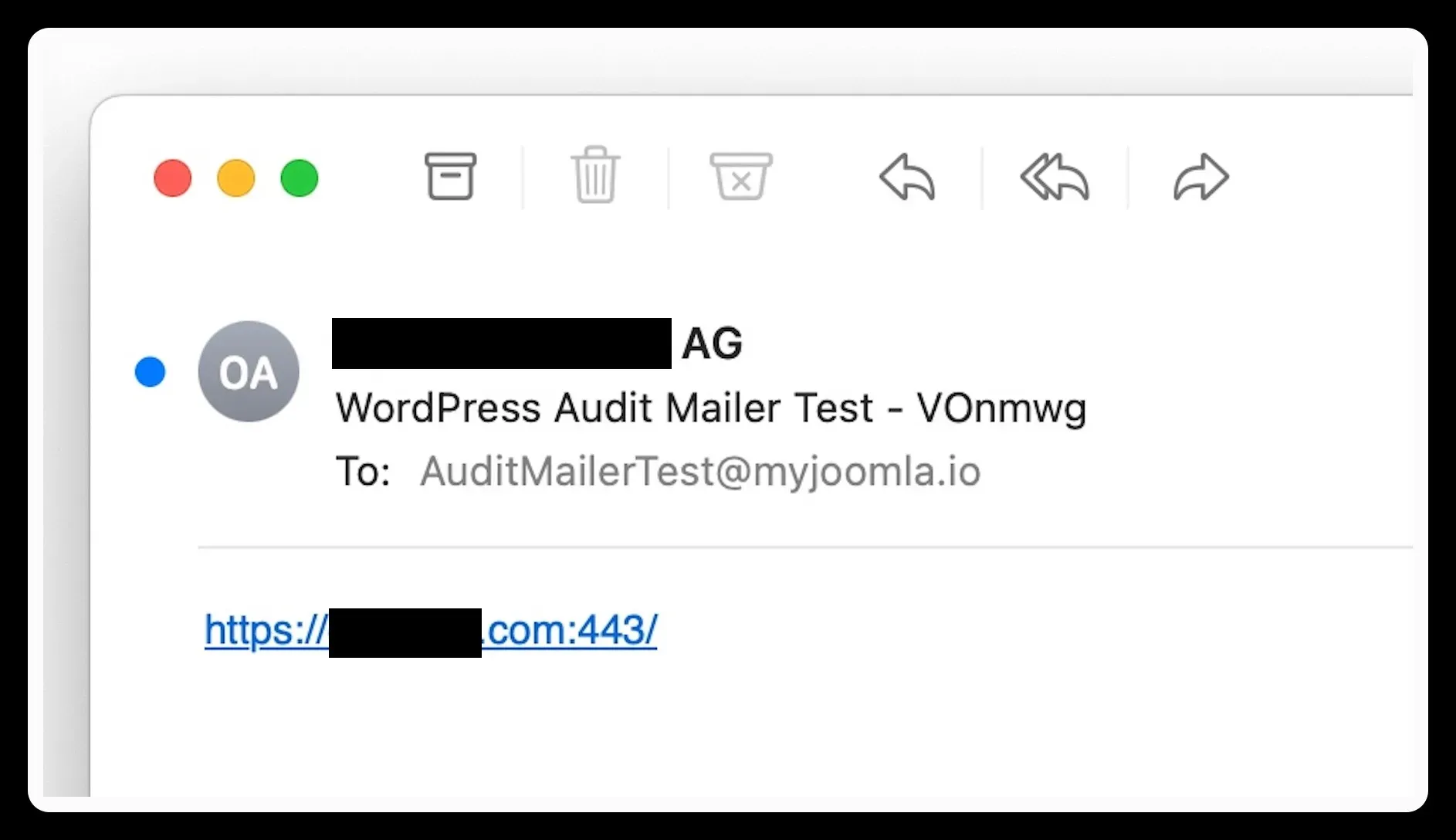
At the start of every mySites.guru audit we ask your Joomla or WordPress site to send a short email to the test address, using whatever mail settings the site is configured with.
The old address was on the myjoomla.io domain because that was the name of the service before we added WordPress support and rebranded as mySites.guru.
If the email arrives, we mark the check as a success in the audit results. If it doesn’t arrive, we flag it as a failure and something to investigate.

This is a valid test to ensure your site can send emails.
Mail to mailer-test@mysites.guru is received by Cloudflare Email Routing. Each test email includes a one-off token that ties it to that audit, so no one can fake a pass for someone else’s site.
If we don’t receive the email, the mySites.guru audit flags it, because it would mean that your Joomla/WordPress site could not send email using its configured method of sending email, and if your site cannot send email you may be losing emails! See how to diagnose and fix your email configuration for a full walkthrough.
Unauthenticated mail fails the test
The new address is stricter than the old one was. The test email has to pass SPF or DKIM for the domain it is sent from, which is the same bar Gmail and Outlook apply. Mail that passes neither is rejected before we see it, and the Email Configuration check fails.
So some sites that passed against the old address now fail. I think that is the right result. A site failing for this reason had a deliverability problem before the move, and it is worth fixing.
If a site has started failing, send its mail through authenticated SMTP with a proper sending service, and get SPF and DKIM passing for the domain the site sends from. The guide on how to verify your Joomla email configuration covers the SMTP settings and the SPF and DKIM records.
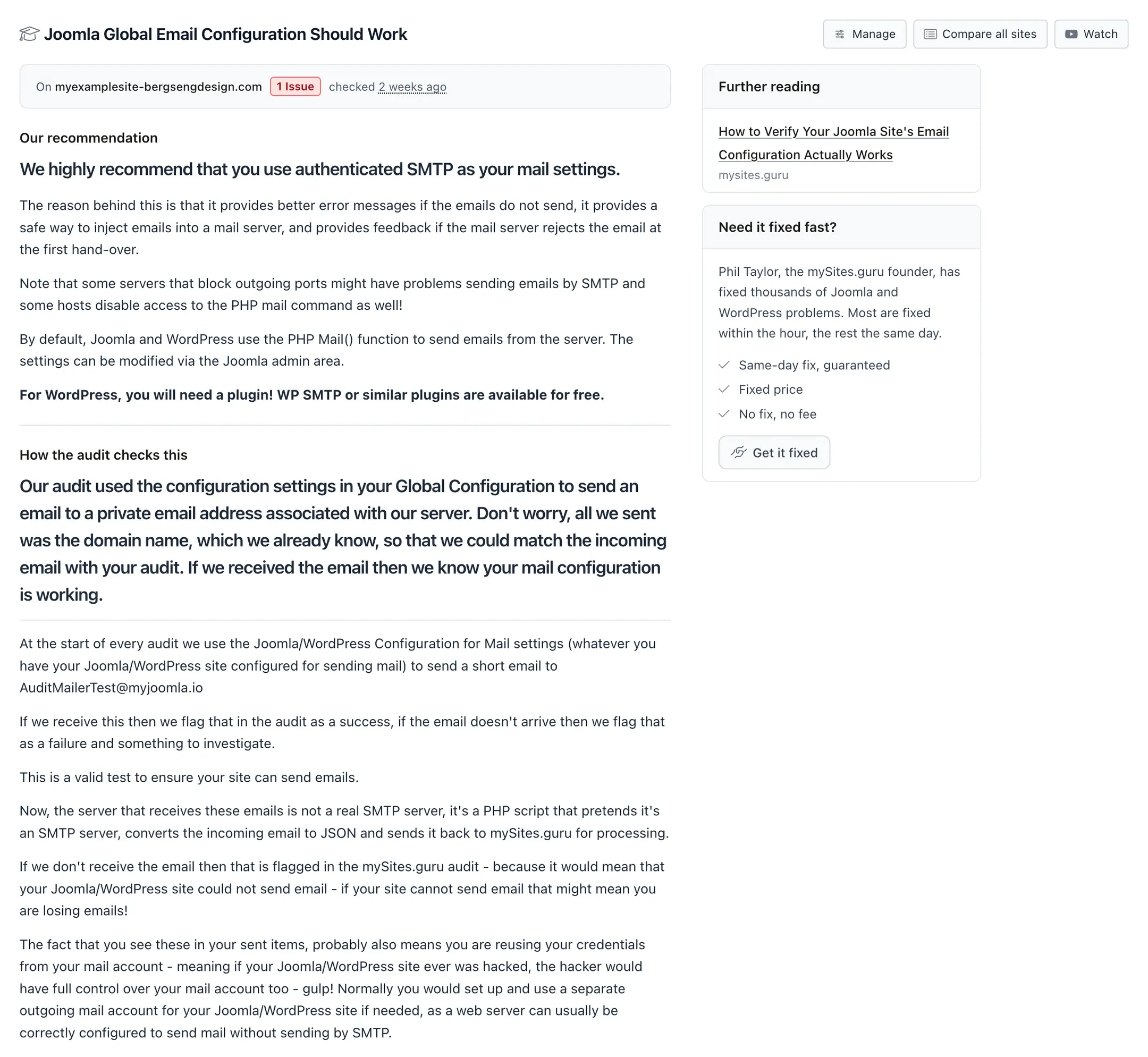
If you can see these emails in your Mail Clients “sent items” folder it probably also means you are reusing your credentials from your mail account with your site - this is bad and should be changed - if your Joomla/WordPress site ever was hacked (like every Joomla 4 version was exploitable to expose configuration.php values, except the latest few!) then the hacker would have full control over your mail account too - gulp! Beyond configuration files, hackers often leave behind hidden dot-files you’d never spot without a dedicated scan.
Normally you would set up and use a separate outgoing mail account for your Joomla/WordPress site if needed, normally a web server can be correctly configured to send mail without sending by SMTP. Personally we recommend using a SMTP service like PostMarkApp.com which provides better outgoing deliverability and visibility of sent emails. For a complete walkthrough of SMTP settings, common mistakes, and DNS configuration, see the full guide on how to verify your Joomla email configuration.
How to Verify Your Joomla Site's Email Configuration Actually WorksRead the full post
If you are receiving bounce backs or server spam error messages - then check your outgoing mail settings - because if you are bouncing or spam flagging our emails, you are probably also flagging emails that are sent from your site.
Send a Test Email Whenever You Want
The audit’s test only runs when an audit does. After you change a site’s SMTP settings, move it to a new host or edit its DNS, you want the answer now, so there is a separate tool for that: Send a Test Email.
Tick up to 20 Joomla or WordPress sites and press Send. Each site sends a real email through its own mail settings to the same mailer-test@mysites.guru address, the way its contact form would, and the results fill in as each one arrives: SPF, DKIM, DMARC, whether it came from your own domain, and how long it took. Nothing is written to the site’s audit, and the test at the start of every audit still runs as before.
Transcript
Is your client’s website email getting through? Mail stops with no warning. The client tells you, weeks later.
Meet Send a Test Email, in mySites.guru. Tick up to 20 Joomla or WordPress sites, and press Send. Each site sends a real email, the way its contact form would. SPF, DKIM, DMARC, the sender, and how long it took to arrive.
Open a site to see what is weak and what to do about it. Then copy the results for their host in one click.
Know the mail works before your client asks. Send a Test Email. In mySites.guru.

You can now turn this test off, per site
For years my answer to “how do I stop these emails?” was that you couldn’t, short of cancelling or never running another audit. Enough of you came back with a fair reason, usually that the site never sends email at all or the host blocks outbound mail, so there is now a switch for it.
Open the site in mySites.guru, click Config, and on the Advanced tab you will find Test Your Site’s Email Settings with a Skip the email test toggle. Turn it on and two things happen: we stop asking that site to send the test email, and the Email Configuration row disappears from its audit results.
Before you turn it on:
- It is per site, not account-wide. Switch it off on the one awkward site rather than across everything.
- It is off by default, so nothing changes on any site you don’t touch.
- It takes effect on that site’s next connector update, usually within 24 hours, so you may get one more test email after you flip it.
I have not removed the check, and I would still rather you left it on. A site that cannot send email is usually a site losing contact form submissions, order confirmations and password resets without anyone noticing, and this test is the cheapest way to find that out before your customers do. But if you already know a site never sends email, there is no point in me proving it every audit.
Frequently Asked Questions
Why is my site sending emails to mailer-test@mysites.guru?
I used to see emails to AuditMailerTest@myjoomla.io - what happened?
What does it mean if the audit reports the email test as failed?
Is it a problem if I can see these test emails in my mail client's sent folder?
Can I stop the test emails without cancelling my subscription?
 Written and edited by a human, with AI assistance. Our approach to AI